

part-singing
- noun
- /ˈpɑrtˌsɪŋɪŋ/
- Specialized
- In music class, students enjoy exploring part singing, where they each sing different melodies that create beautiful harmonies.
Examples
-
Students will succeed in part singing only after they can demonstrate the ability to sing in tune, discriminate between pitches, internalize melodies, and keep the beat.
Academic text (1997) -
Because most students develop the ability to hear and sing harmonically between the ages of nine and thirteen, teachers tend to introduce part singing in the upper elementary grades.
Academic text (1997) -
However, if students are ready, part singing may be introduced in the primary grades.
Academic text (1997) -
The National Standards for Music Education provide guidelines and achievement standards for developing part singing.
Academic text (1997) -
After they have mastered these skills, they are ready to learn part singing.
Academic text (1997) -
Depending on the students' age and ability, and the number of times music classes meet per week, the process may take one year or several; it is time well spent because part singing is an important goal in musical development.
Academic text (1997) -
Several preparatory steps should be taken before actual part singing begins.
Academic text (1997) -
Children recognize that part singing is a sophisticated skill that involves both listening and singing, and they are proud when they can achieve it.
Academic text (1997) -
Ask students to think of ways to begin in unison and move to part singing in the first few notes of the "Alleluia."
Academic text (2003) -
Introduced methodically and incrementally, part singing can build harmonizing skills while helping students meet National Standards requirements.
Academic text (1997)
Synonyms

 1
8.6
1
8.6

Music with several different melodies heard at the same time
 1
2.9
1
2.9
Music that people sing with or without instruments


 1
4.3
1
4.3
Three voices or instruments sing different notes together to make a full sound
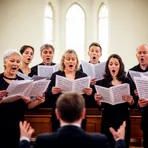
Music for several voices that sing different parts without instruments

Different voices sing together to make a rich harmony
Antonyms

How Complex

Surface Forms
Morphology
Etymology
Part-singing comes from the simple words part ('a piece') and singing, and it pictures different voices each singing their own part that fit together like pieces of a puzzle to make a rich harmony.