
parliamentary monarchy
- noun
- /ˌpɑːrlɪˈmɛnˌtɛri ˈmɒnərki/
- Specialized
- The 1978 constitution defines Spain as a parliamentary monarchy and "a social and democratic state ruled by law."
Examples
-
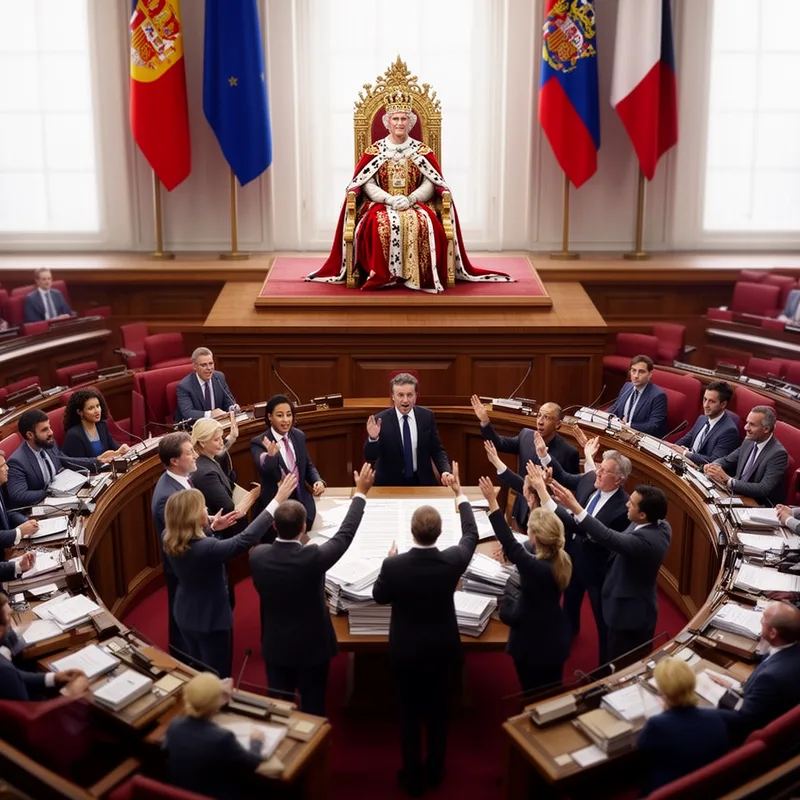
In a parliamentary monarchy, the monarch serves as a ceremonial figure while the elected parliament handles legislative responsibilities.
-
This was a time in which an extraordinary group of rational and far-sighted MPs made the case for a limited form of parliamentary monarchy in the face of the absolutist tendencies of James I.
Academic text (2011) -
The most delicate subject, of course, was the king's status; slogans calling for a "parliamentary monarchy" indicated that the protesters sought a clearer, more limited definition of the king's sweeping powers in favor of their elected representatives.
Academic text (2012) -
Flanders, a parliamentary monarchy, is divided into three regions and three communities: the Flemish region (the Flemish community), the Walloon region (a French community and a very small German community), and the region of Brussels (Flemish and French communities).
Academic text (1994) -
Spain is known for being a parliamentary monarchy, where the king's powers are defined by the constitution.
-
The government of the United Kingdom is often cited as an example of a parliamentary monarchy that balances tradition and democracy.
Synonyms

 66
3.9
66
3.9

A country ruled by a king or queen who usually inherits the position
How Concentrated
- Formal
19
9.3

- Formal
3
8.1
11
8.7
- Specialized
802
3.2
Surface Forms
Morphology
The phrase is directly compositional: 'parliamentary' (relating to a parliament) modifies 'monarchy' (rule by a monarch), so the combined meaning — a monarchy in which parliament plays a governing role — follows naturally from the parts. This is a common, cross-linguistically transparent construction, so a B1 learner who knows both constituents can reasonably infer the intended meaning.
Etymology
Parliamentary monarchy comes from joining two simple ideas: a monarch (a king or queen) and a parliament (a group of elected people who 'make laws'). So imagine a crowned ruler who is the country's 'head of state' but who must follow the parliament, which is why the phrase means a system where the monarch has limited power and the parliament makes the laws.