

pagoda tree


 1
9.3
1
9.3
- noun
- Walking through the botanical garden, I admired the elegant pagoda trees adorned with clusters of fragrant white flowers.
Examples
-
In the temple garden, the beautiful pagoda tree stood tall, its fragrant yellow flowers attracting many visitors.
-
She peered over the side at densely grown pagoda trees.
Fiction book (2001) -
Early May is when the pagoda trees bloom.
Fiction book (1990) -
Many ragged pagoda trees along the banks leaned over the river.
Fiction book (1998) -
A wall of strangely canted pagoda trees blocked her path.
Fiction book (2001) -
She flew past wind-torn pagoda trees and sank into the dense forest.
Fiction book (2001) -
You don't answer her but point to the flowers beneath the pagoda trees on the dike, the indica so purple they set the heart aquiver.
Fiction book (1990) -
During the summer, the pagoda tree fills the air with a sweet scent as it blooms in vibrant colors.
Synonyms

A tree that loses its leaves and has dark green leaf groups and creamy-white fragrant flowers
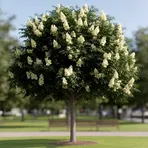
A tree with dark green divided leaves and clusters of creamy-white fragrant flowers
How Tall

Surface Forms
Morphology
pagoda + tree
The compound "pagoda tree" is a literal noun–noun combination whose meaning (a tree associated with or commonly found near pagodas/temple gardens, or named for its relation to pagodas) follows directly from 'pagoda' + 'tree'. This is a descriptive botanical name rather than an idiom, so a B1 learner who knows both constituents would readily infer the meaning; such compounding is cross-linguistically common.
Etymology
Pagoda tree is named after the pagoda, the tall temple buildings in Asia with many roofs. One popular story says people planted the pagoda tree near temples because its branches in layers and bright flowers looked like the roofs of a small pagoda, so the name now helps you picture a tall, elegant tree often found in temple gardens.