
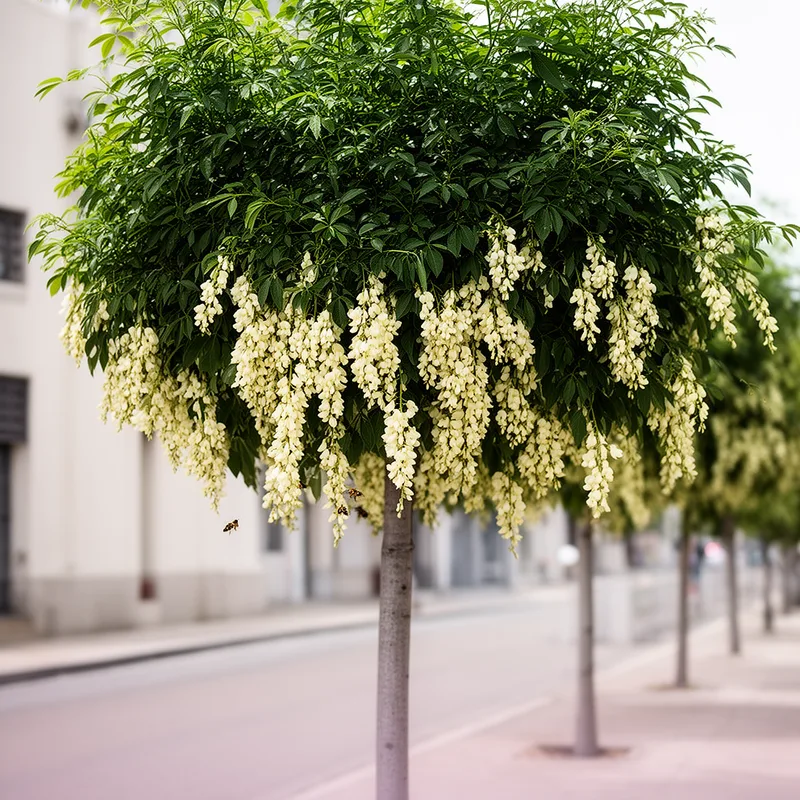
Chinese scholar tree
- noun
- We admired the clusters of creamy-white flowers on the Chinese scholar tree while walking through the park.
Examples
-
Mother falls down under an old Chinese scholar tree, her eyes glazed like porcelain.
Fiction book (1992) -
I found it in the bushes by the Chinese scholar tree.
Fiction book (1992) -
The garden was filled with the sweet scent of blossoms from the Chinese scholar tree in spring.
-
Children enjoyed playing in the shade of the tall Chinese scholar tree during the hot summer days.
Synonyms

A tree from China and Japan that loses its leaves and has dark green leaves and fragrant white flower clusters

A tree from China and Japan with dark green leaves and clusters of fragrant creamy-white flowers
A tree with dark green divided leaves and clusters of creamy-white fragrant flowers

A tree from China and Japan with a rounded top, dark green leaves, and many fragrant creamy-white flowers
Surface Forms
Morphology
The phrase is directly compositional: 'Chinese' signals origin, 'scholar' labels the type/name, and 'tree' identifies it as a plant. A B1 learner who knows the constituent words will readily infer that this is a kind of tree associated with China (or named after scholars), even if they cannot deduce specific botanical details.
Etymology
Chinese scholar tree may get its name from the old habit of planting this tree near schools and temples, where a scholar sat in its shade to 'study'. So the name connects the tree to 'scholars' and learning.

