
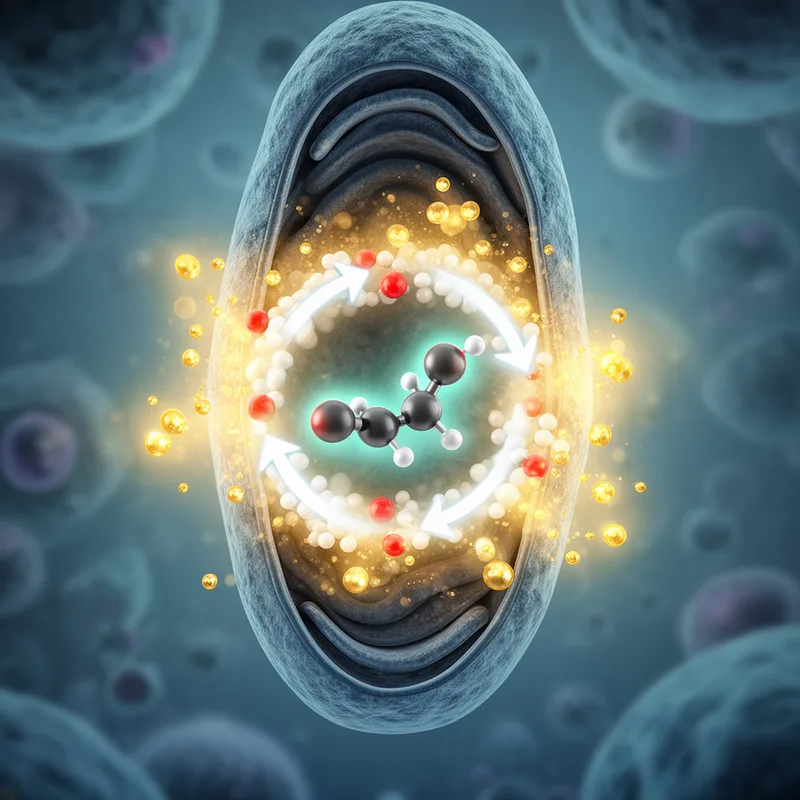
oxaloacetic acid


 1
7.9
- noun
- /ˌɑksəloʊəˈsɛtɪk ˈæsɪd/
- Specialized
- Oxaloacetic acid plays a crucial role in the Krebs cycle, enabling cellular energy production in most organisms.
Examples
-
During exercise, oxaloacetic acid concentrations can affect how fats and carbohydrates are metabolized.
-
Doctors may refer to levels of oxaloacetic acid when studying certain metabolic disorders.
-
Scientists study oxaloacetic acid for its role in metabolism.
-
The body produces oxaloacetic acid during the citric acid cycle.
-
Oxaloacetic acid plays a crucial role in the Krebs cycle, enabling cellular energy production in most organisms.
-
Doctors may refer to levels of oxaloacetic acid when studying certain metabolic disorders.
-
During exercise, oxaloacetic acid concentrations can affect how fats and carbohydrates are metabolized.
Synonyms
 1
9.5
A chemical made in cells that helps in energy reactions like the citric acid cycle
 1
9.2
A chemical in cells that helps make energy from food

A chemical in cells that helps make energy from food
Surface Forms
Morphology
oxaloacetic + acid
The headword contains the common noun 'acid', so a B1 learner who knows the constituents would at least be able to infer that this is a kind of acid. However, the modifier 'oxaloacetic' is a technical, specialized chemical term (not decomposable into familiar everyday morphemes for a B1 learner), so the specific biochemical meaning and structure cannot be derived without domain knowledge. Because the phrase yields partial information (category = acid) but not the full meaning, it is best treated as semi-transparent.
Etymology
Oxaloacetic acid comes from joining the name parts oxal- (from an old word for 'sour' plants) and acetic (from the word for 'vinegar'), because early chemists saw bits like oxalic and acetic acids in this compound. So the name literally points to a kind of 'acid' and helps you remember it is an important chemical used in cells.