
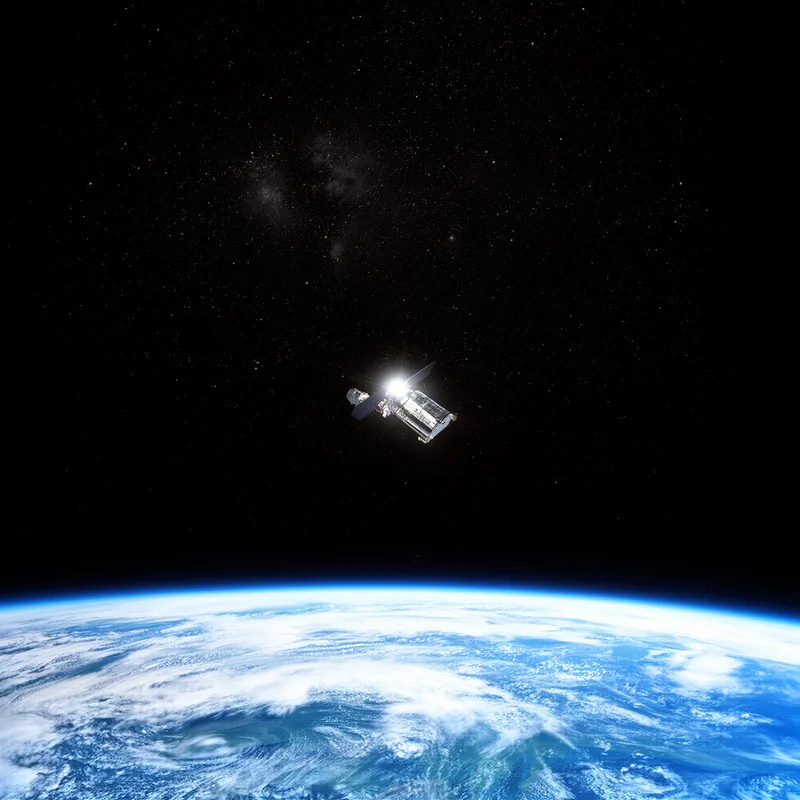
outer space
 91
3.0
91
3.0

- noun
- /ˈaʊtər speɪs/
- If aliens had come from outer space, the entire world could righteously unite to fight that.
- vacuum of outer space
- radiation from outer space
- cosmic radiation from outer space
Loading YouTube…
Watch on YouTubeShe's like an alien from outer space examining the human race.
- She's like an alien from outer space examining the human race.
- The company has shipped wine into outer space and says that it ages faster.
- There's cosmic radiation from outer space that usually flips your your quantum bits.
- Or do you want to look at the Earth from outer space?
- So I'm currently holding a rock from outer space.
- If they hit a bump, they'll just float off into outer space.
- Alien big cats to be literal, as in cats from outer space.
- And From the humble Band-Aid to the big questions of outer space.
- Before we explore the space, outer space beyond our orbit, we'll have to explore the space within.
- He sent several people into outer space.
- And I wanted to be me dating this, you know, alien boy from outer space.
- I mean, they, they had no information, nothing like what we have now about outer space.
- If aliens had come from outer space, the entire world could righteously unite to fight that.
Examples
-
The company has shipped wine into outer space and says that it ages faster.
-
One says that perhaps another planet from outer space will come near the earth, disrupt the whole solar system.
-
It's supposed to be from a different planet in outer space!
-
Some people thought that outer space was what everything was really all about.
Fiction book (1999) -
And they exist in deep outer space where the temperatures are are pretty cold, right.
-
We can gain some insight here by examining the worlds of inner and outer space.
Academic text (2004) -
She's been dropped on our planet from outer space, I figure, and it's taking her a while to adjust.
Fiction book (1991) -
Because the drone had been designed to operate in outer space without a crew, it had no airlock.
Fiction book (1999) -
But maybe using a quantum computer, we may be able to go through the mountains of data coming from outer space and find the signals of intelligence.
-
Astronauts conduct research and experiments in outer space to understand the effects of microgravity.
Synonyms
 ∞
2.0
∞
2.0
The region beyond Earth's atmosphere where stars and planets are
How Far

Surface Forms
Morphology
The compound 'outer space' is compositionally built from 'outer' (external) + 'space' (the cosmos), so a B1 learner who knows both constituents can infer it refers to the region outside Earth's atmosphere. This is a straightforward descriptive noun phrase and parallels equivalent constructions in many languages, making its meaning transparently derivable from the parts.
Etymology
Outer space comes from the simple idea of outer meaning 'outside' and space meaning an 'empty' area beyond the air around Earth. So, outer space now means the area beyond the air around Earth where stars, planets, and satellites are found.