
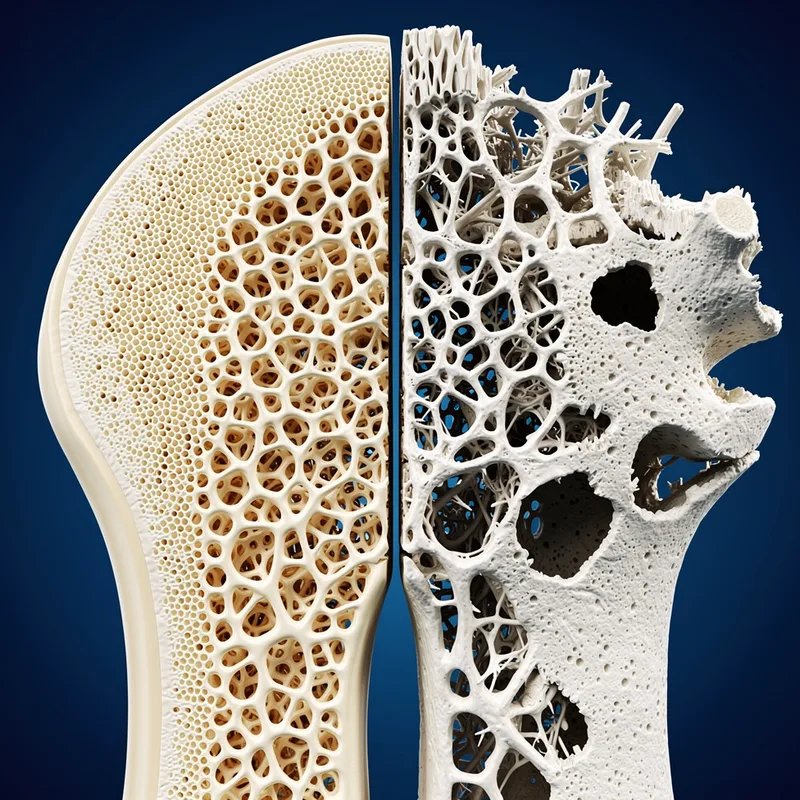
osteoporosis
 34
6.1
34
6.1

- noun
- /ˌɑːstɪəʊpəˈroʊsɪs/
- Specialized
- Countries with little or no milk consumption may show less incidence of osteoporosis than countries with high consumption.
- risk of osteoporosis
- prevention of osteoporosis
- risk factors for osteoporosis
Loading YouTube…
Watch on YouTubeAnd then if you show up with AT score that shows that you have frank osteoporosis.
- And then if you show up with AT score that shows that you have frank osteoporosis.
- So these males actually go through a brittle boned osteoporosis.
- Osteopenia is a description of a lesser condition which you're progressing to osteoporosis.
- I stopped last month because I found out that I had osteoporosis in my spine, have osteoporosis in my spine.
- A lot of them have walking sticks, you know, yeah, because they have osteoporosis.
- So there's there's no evidence that calcium helps people, doesn't help broken bones, it doesn't help osteoporosis, all the things that we were told it did do.
- It was believed that if vitamin D had any role, it was for bone health and preventing fractures, preventing osteoporosis.
- And for men actually, even though the osteoporosis instance is less than women, their causality of death, their death due to falls is higher than women.
- And then they found osteoporosis, full osteoporosis, and the person sustained A compression fracture in his spine, causing permanent disability.
- You've heard that coffee causes heart disease, cancer, osteoporosis.
- If he, you know, still didn't have much osteoporosis and you could have him just right by the door, just all taxidermied up, you know, don't forget your jacket, Pop Pop has it.
Examples
-
Musculoskeletal conditions, most notably arthritis, osteoporosis, and fractures, are major causes of disability among elderly people.
Academic text (1995) -
Many postmenopausal women experience osteoporosis, which can lead to painful fractures.
-
And it is, and women are by far more affected by osteoporosis than men.
-
Groups at increased risk of osteoporosis are shown in Box 1.
Academic text (2012) -
- How long have you had osteoporosis?
-
As a child, I knew her only after she had developed osteoporosis.
-
People tend to associate osteoporosis mainly with women, but it also affects men.
Academic text (2015) -
Mrs. Jones also expressed some concern about osteoporosis because she was postmenopausal.
Academic text (2004) -
The fractures that typically arise from osteoporosis are fractures of the hip, the spine, and the distal forearm or wrist.
-
If left untreated, osteoporosis can cause serious health issues due to fragile bones.
How Fragile
- Specialized
34
6.1

- Specialized

 1
7.4
1
7.4
Surface Forms
Morphology
osteoporosis = porosity (opaque) = osteo + porosis
The parts are Greek combining forms ('osteo-' and '-porosis') that are not familiar productive English morphemes to average learners, so the condition's meaning is not directly derivable.
Etymology
Osteoporosis comes from Greek parts osteo- meaning 'bone' and poros meaning 'pore' or 'passage'. So it literally means 'bones with holes', like the English word porous, which explains why bones become weak and easy to break.