
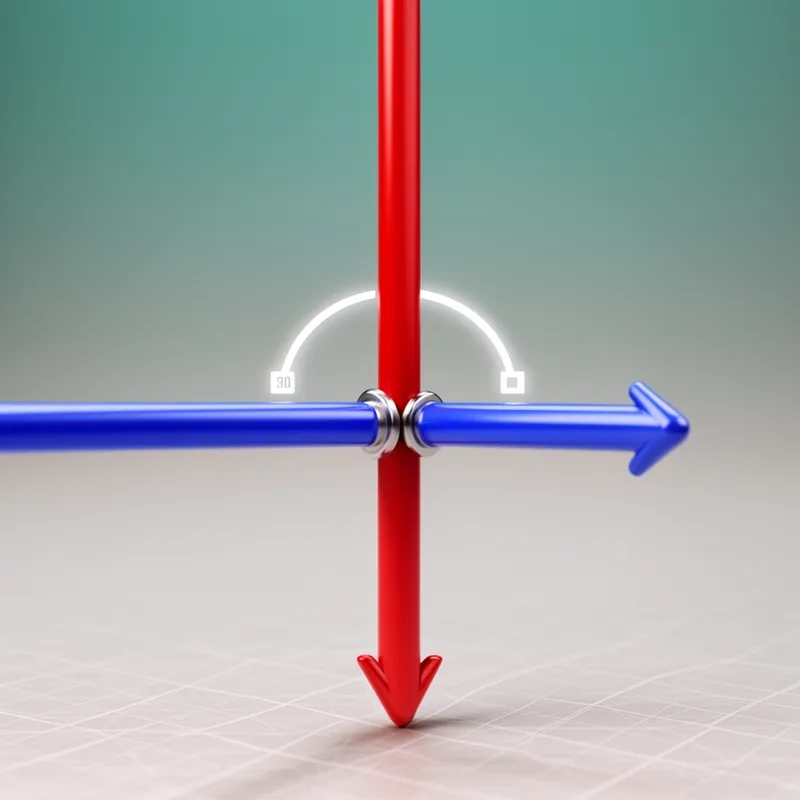
orthogonal opposition
- noun
- Specialized
 :
oposición ortogonal
:
oposición ortogonal
- In mathematics, two lines that are in orthogonal opposition intersect at a 90-degree angle.
Examples
-
The architect used lines in orthogonal opposition to create a striking geometric pattern.
-
The two lines form an orthogonal opposition in this diagram.
-
In mathematics, vectors in orthogonal opposition have a dot product of zero.
-
These molecular axes are in orthogonal opposition, maximizing their spatial separation.
-
In geometry, orthogonal opposition is crucial for understanding angles.
-
The architect designed the building with windows in orthogonal opposition to enhance light flow.
-
In a Cartesian coordinate system, axes are positioned in orthogonal opposition to each other.
Synonyms

The state of two things being at right angles and not affecting each other, like two lines at 90 degrees
Two lines or surfaces meet at a right angle
Surface Forms
Morphology
The phrase is a straightforward adjective+noun composition: 'orthogonal' means at right angles and 'opposition' denotes an opposing relation, so together they denote an opposition at right angles. This relationship is directly derivable from the constituents and follows normal English composition patterns, so a learner who knows both words would understand the MWE.
Etymology
Orthogonal opposition paints the image of two lines or arrows meeting at 'right angles'; orthogonal means at a 'right angle' and opposition means they face or stand against each other. So the phrase is used for things that are at right angles in space or, for ideas and systems, for parts that 'do not affect each other'.

