
orientalizing
- noun
- /ˌɔːrɪˈɛntəlaɪzɪŋ/
- Specialized
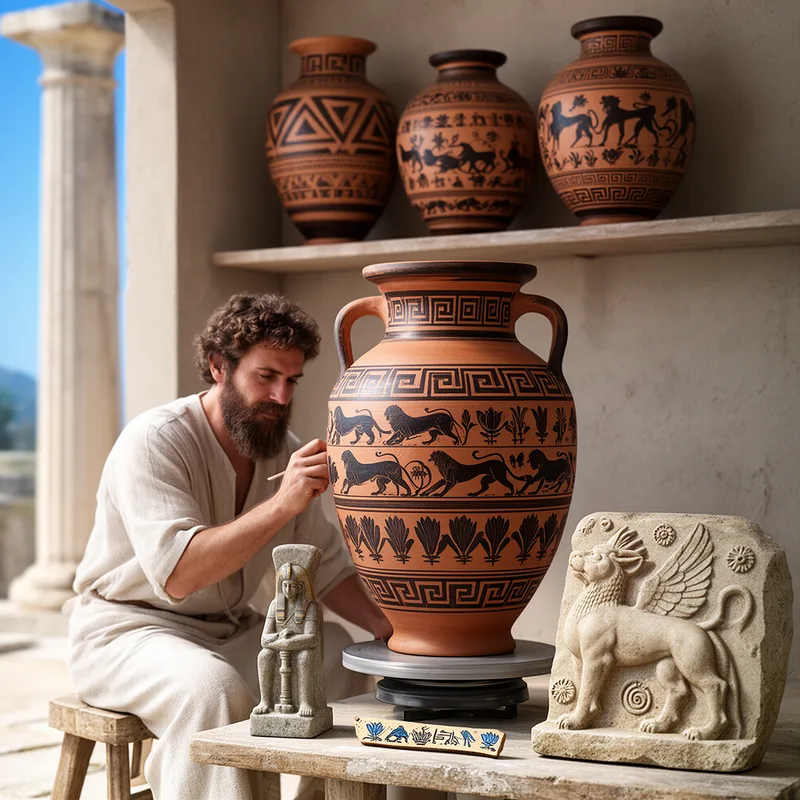
- Artists from the Orientalizing period often integrated Egyptian styles into their designs.
Examples
-
In other words, we fear that a textual focus on Orientalizing, like Orientalizing itself, may curtail our understanding of more fundamental processes.
Academic text (1991) -
The Orientalizing phase of art showcases the influence of Near Eastern motifs on early Greek works.
-
Orientalizing is the presentation of the "other" in essentialized form as "absolutely different."
Academic text (1991) -
Same thing goes for Oriental orientalizing pictures of, you know, things happening in India or China with, you say, Buddhist art.
-
Both date to the seventh century B.C., the Orientalizing period, so called due to the influence on the Etruscans from the eastern Mediterranean.
Academic text (2010) -
In the Near East, Edward Saeed was absolutely right to castigate our Orientalizing prejudices.
-
Both of these photographs cast light on the process of "Orientalizing"—a process that has been the subject of considerable discussion in recent years.
Academic text (1991) -
In so doing, Chambri will not only experience class inequalities for the first time within their home territory, but also will be engaging in a form of indigenous ethno-orientalizing—portraying themselves in response or, perhaps, in resistance to images they think we have of them.
Academic text (1991) -
And, as Edward Said observes, orientalizing is not just about holding difference at arm's length and enjoying the view; it's also about exploiting difference as a gyroscopic mechanism that allows the center to stabilize itself in relation to an absolute periphery.
Academic text (2008) -
The first explicitly Orientalizing treatment of Paris in Greek art may have been by Polygnotus in the famous lost Nekyia cycle at the Knidian Lesche at Delphi, described for posterity by Pausanias 10.31.8.
Academic text (2012)
How Orientalist


Surface Forms
Morphology
orientalizing = orientalize (semi-transparent) = oriental + ize + ing
Formed by productive nominalization (-ing) of the verb 'orientalize'; the morphological step is regular and predictable.
Etymology
Orientalizing comes from Orient, which means 'east', and the ending -ize, which means 'to make', so it literally means 'making something eastern'. It is used for the time when Greek artists borrowed designs and ideas from Egypt and the Near East, which is why the word describes art that shows eastern influence.