

oriental plane
- noun
- Specialized
- The oriental plane tree is renowned for its broad leaves and striking mottled bark.
Examples
-
The park is shaded by several ancient oriental planes that provide cool relief in summer.
-
The oriental plane is often planted along avenues in southern Europe due to its hardiness.
-
Botanists admire the patterned bark of the oriental plane for its unique appearance.
-
The oriental plane tree can grow up to 30 meters tall.
-
Have you seen the beautiful oriental planes in the park?
-
Many municipalities plant the oriental plane along their streets to enhance the beauty of the landscape.
-
Children often play under the shade of the large oriental planes in the local park.
Synonyms

 1
6.1
1
6.1

A large tree with pale, peeling bark, broad leaves, and round seed balls that gives shade
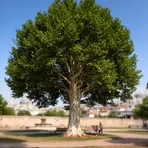
A large tree with broad leaves from southeastern Europe and western Asia, often planted in parks for shade
Surface Forms
Morphology
oriental + plane
The noun is compositionally adjective + noun (oriental = from the east; plane = a type of tree), so if a learner knows the botanical sense of 'plane' they can derive the meaning as a plane tree from the east. However, 'plane' has more frequent senses (airplane, flat surface) and the tree sense is lower-frequency and domain-specific, so the interpretation is not fully predictable for an average B1 learner.
Etymology
Oriental plane is a name made of oriental, meaning 'east', and plane, an old name for a tree with big, flat leaves. So the name simply tells you it is a plane tree from the east, which is why people use it for the large trees with broad leaves you see in parks and streets.