

order Anura
- noun
- /ˈɔrdər əˈnʊrə/
- Specialized
- Unlike newts or salamanders, all members of the order Anura lack tails as adults.
Examples
-
The order Anura consists of various species of frogs.
-
Scientists study the order Anura to understand amphibian evolution.
-
The order Anura encompasses more than 7,000 species of frogs and toads worldwide.
-
Did you know that the order Anura includes over 7,000 species?
-
The order Anura is characterized by its members having a jumping locomotion.
-
Biologists study the order Anura to understand amphibian evolution and ecology.
-
Many species within the order Anura are known for their unique calls during mating season.
Synonyms

A group of amphibians like frogs and toads that have no tail as adults
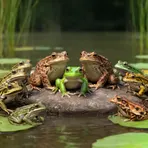
A group of amphibian animals like frogs and toads

A group used in older biology to include frogs and toads
Surface Forms
Morphology
This phrase is fully compositional: 'order' denotes a taxonomic rank and 'Anura' is the name of that rank (tailless amphibians), so the combined meaning is directly the taxonomic group called Anura. Taxonomic naming patterns (rank + name) are cross-linguistically common, so a learner who knows both constituents will readily understand the MWE.
Etymology
The name order Anura comes from Greek parts an- ('without') and oura ('tail'). It literally means 'without a tail', so it is used for frogs and toads that do not have tails as adults.

