
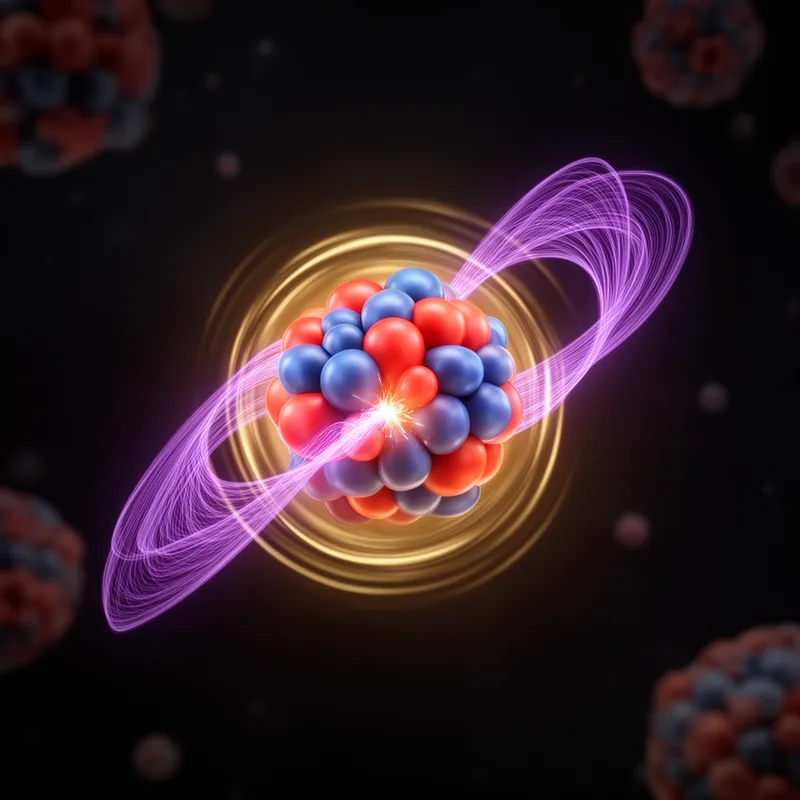
nuclear resonance
- noun
- Specialized
- Precise measurements were made using nuclear resonance to analyze the interaction between gamma rays and nuclei.
Examples
-
Researchers used nuclear resonance techniques to study the properties of various isotopes.
-
Can nuclear resonance be used in medical imaging?
-
The discovery of nuclear resonance greatly advanced our understanding of atomic nuclei.
-
The phenomenon of nuclear resonance is crucial in quantum physics.
-
The scientist explained that nuclear resonance could help us understand the structure of atomic nuclei.
-
By using nuclear resonance, researchers can identify specific isotopes in a sample.
-
During the experiment, the team measured the nuclear resonance to detect the gamma rays emitted by the nuclei.
Surface Forms
Morphology
The phrase combines 'nuclear' (relating to atomic nuclei) and 'resonance' (an excitation or oscillatory response), so a learner who knows the parts can infer it refers to a resonance phenomenon involving nuclei. However, the precise technical meaning (specific gamma‑ray absorption by an identical emitting nucleus) is specialized domain knowledge not predictable from the constituents alone, so the term is not fully transparent to an average B1 learner.
Etymology
The term nuclear resonance links nuclear, meaning the atom's tiny center, and resonance, meaning a matching note: imagine one nucleus giving off a gamma ray and another nucleus having the same exact energy so it 'resonates' and 'absorbs' the ray. So, the phrase means a nucleus takes in a gamma ray because it 'matches' the ray's energy.

