
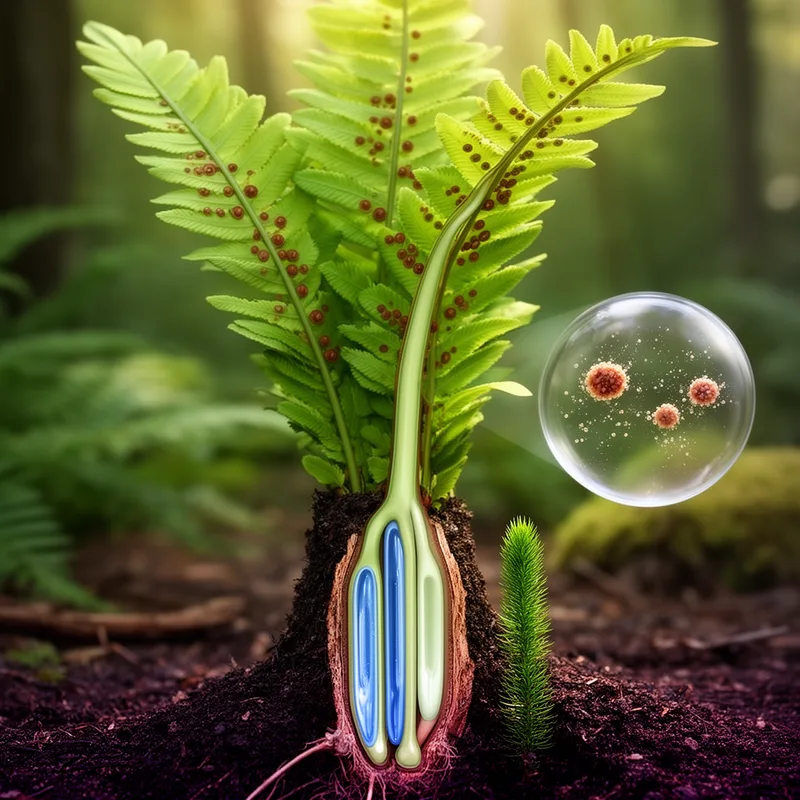
nonflowering plant
- noun
- /nɒnˈflaʊərɪŋ plænt/
- Specialized
- Ferns and mosses are classic examples of nonflowering plants found in temperate forests.
Examples
-
Unlike most trees, clubmosses are nonflowering plants that do not bear seeds.
-
In biology class, we learned that nonflowering plants reproduce using spores instead of seeds.
-
Botany students studied the lifecycle of nonflowering plants for their final project.
-
A nonflowering plant does not produce flowers.
-
Mosses are a type of nonflowering plant.
-
Mosses and ferns are examples of nonflowering plants that thrive in damp environments.
-
The instructor explained that a nonflowering plant includes species like ferns, which do not produce flowers.
Synonyms

A plant like a fern that has tubes to move water and makes spores instead of seeds
Plants like ferns and horsetails that have tubes to carry water and reproduce by making spores instead of seeds
Antonyms


Surface Forms
Morphology
The phrase combines the adjective 'nonflowering' (not producing flowers or seeds) with the noun 'plant', so its meaning — a plant that does not produce flowers — is directly and compositionally derivable from its parts. This negation + noun construction is morphologically regular and cross-linguistically common, so a B1 learner who knows the constituents will readily understand it.
Etymology
Nonflowering plant is a simple, literal name: non- means 'not' and flowering means 'making flowers'. So it refers to plants like ferns and mosses that reproduce by 'spores' instead of 'seeds'.