
nitrogen cycle
- noun
- /ˈnaɪtrədʒən ˈsaɪkəl/
- Specialized
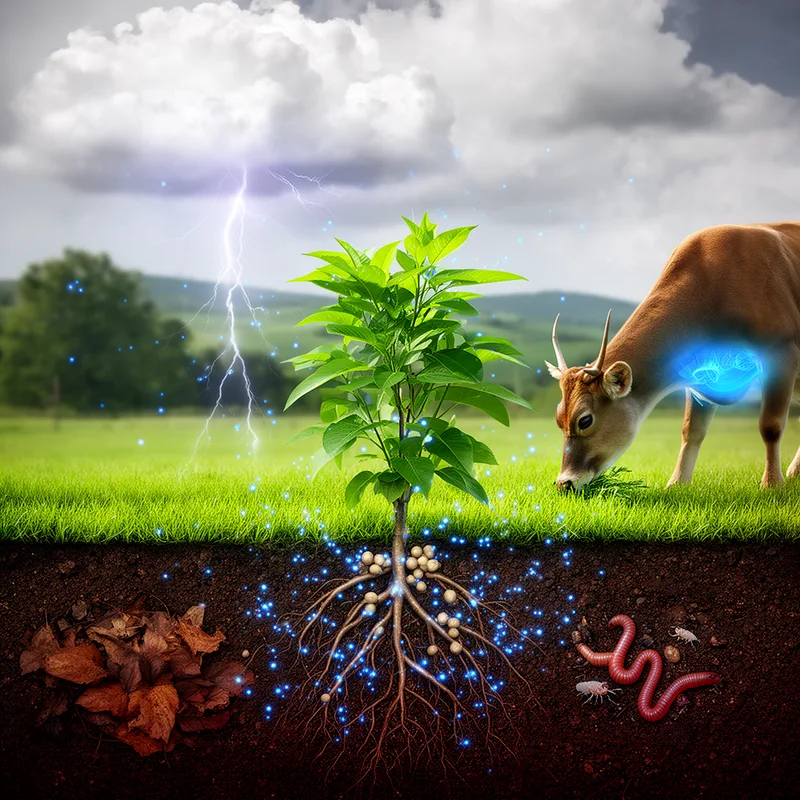
- The nitrogen cycle involves processes like decay, which return nitrogen to the soil.
- the global nitrogen cycle
- disruption of the nitrogen cycle
- nitrogen cycle bacteria
Examples
-
The nitrogen cycle is essential for maintaining the balance of nitrogen in ecosystems.
-
The professor, however, had spent considerable time in his lecture going over components of the nitrogen cycle.
Academic text (1999) -
To understand how to alleviate these effects, we must first understand the nitrogen cycle itself.
Academic text (1994) -
Humans are greatly perturbing the global nitrogen cycle.
Academic text (1994) -
Recent advances in environmental microbiology have revealed previously unknown bacteria and pathways in the nitrogen cycle that tell a far more complex story.
Academic text (2008) -
Consensus among researchers is growing that the scale of disruption to the nitrogen cycle may have global implications comparable to those caused by disruption of the carbon cycle.
Academic text (2000) -
As we come to understand anthropogenic disruptions of the biosphere more deeply, we may find the nitrogen cycle sharing center stage as an agent of long-term environmental change.
Academic text (1994) -
In the framework of global and regional environmental change, anthropogenic disruptions of the nitrogen cycle may be as significant as anthropogenic disruptions of the carbon cycle, even though the nitrogen cycle has received far less attention.
Academic text (1994) -
Soil invertebrates can play an important role in the nitrogen cycle through their redistribution and comminution (or pulverization) of detritus.
Academic text (1994) -
Our discussion will concentrate on global-scale biological nitrogen cycles (excluding tectonic cycling), with particular attention to nitrogen cycling within terrestrial ecosystems.
Academic text (1994)
Surface Forms
Morphology
The meaning is directly derivable from the constituents: 'nitrogen' (the element/gas) plus 'cycle' (a repeating sequence/process) clearly yields a recurring natural process involving nitrogen. This is a productive, cross-linguistically common compound pattern (e.g. 'water cycle', 'carbon cycle'), so a B1 learner who knows both words would readily infer the MWE meaning.
Etymology
The noun nitrogen cycle paints a picture of nitrogen taking a repeating trip through nature. Plants take it, animals eat the plants, and when they die it returns to the soil or air with help from tiny creatures that change it, so cycle shows why the phrase means 'the natural process of nitrogen moving and changing forms'.

