
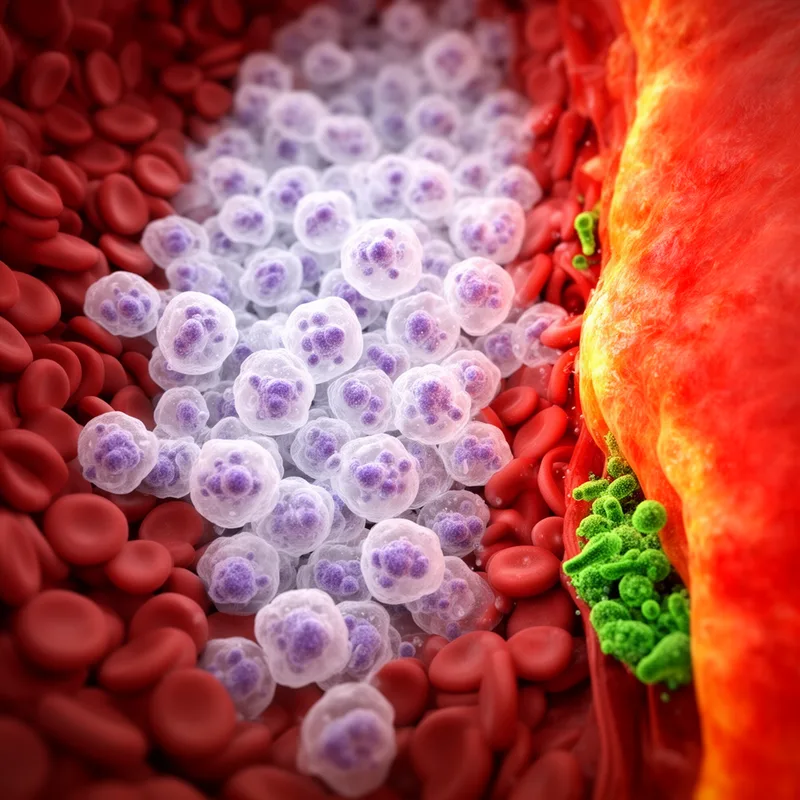
neutrophilia


 1
9.5
- noun
- /ˌnjuːtrəˈfɪliə/
- Specialized
- Fever developed in the patient 3 days after admission, and clinical tests showed peripheral leukocytosis with neutrophilia (Table).
- leukocytosis with neutrophilia
Examples
-
The disease is associated with an elevated erythrocyte sedimentation rate, leukocytosis, neutrophilia, and anemia.
Academic text (1998) -
The patient's neutrophilia indicated a likely infection that required immediate treatment.
-
The neutrophilia across the intervals in all the treatment groups reflects stress increases on the immune system.
Academic text (2007) -
Routine serology showed neutrophilia (88%) and an elevated total white blood cell count of 15 x 10^9/L.
Academic text (2008) -
Doctors noted neutrophilia in the blood tests, suggesting the body was responding to an underlying inflammation.
-
During the follow-up, the presence of neutrophilia in her blood results confirmed the ongoing immune response.
Antonyms
- Specialized
1
8.6
A condition when the body has too few neutrophils, the white blood cells that fight infection
How Many
- Specialized
1
9.5

- Specialized
1
8.6
Surface Forms
Morphology
neutrophilia = neutrophil (semi-transparent) = neutrophil + ia
Formed by the medical base 'neutrophil' plus the condition-forming suffix '-ia'; the composition is regular in medical terminology but understanding the precise clinical sense ('increase in number') requires medical knowledge.
Etymology
The word neutrophilia comes from neutro- (from neutrophil, a common white blood cell) and -philia ('a liking for' or 'more of'). So neutrophilia means having more neutrophils in the blood, which often happens when the body is fighting an infection.