

nettle-leaved goosefoot
- noun
- UK
- The field was full of nettle-leaved goosefoot, easily recognized by its jagged-edged leaves.
Examples
-
You can find nettle-leaved goosefoot growing in disturbed soils across North America.
-
The distinctive leaves of nettle-leaved goosefoot can help identify it among other plants in the wild.
-
Gardeners often remove nettle-leaved goosefoot as it can become an invasive weed.
-
The nettle-leaved goosefoot is often found in disturbed areas.
-
Many gardeners dislike nettle-leaved goosefoot for its invasive nature.
-
Many gardeners find nettle-leaved goosefoot troublesome due to its rapid spread in their flower beds.
-
You can often see nettle-leaved goosefoot thriving in abandoned lots and other disturbed areas.
Synonyms
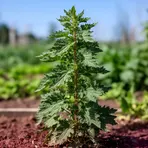
A plant from Europe that lives one year, now common in North America, with coarse, toothed leaves

A small annual plant with rough toothed leaves that often grows as a weed near roads and fields
Surface Forms
Morphology
nettle-leaved + goosefoot
The noun phrase is fully compositional: 'goosefoot' names the plant and 'nettle-leaved' describes its leaves as resembling those of a nettle. The descriptive pattern 'X-leaved Y' is a common, transparent compound formation in English (and cross-linguistically), so a B1 learner who knows 'nettle' and 'leaf' can infer the meaning.
Etymology
Nettle-leaved goosefoot comes from how the plant's leaves look: nettle-leaved means the leaves have toothed edges like a nettle, and goosefoot says the leaf shape looks a little like a goose's foot. So the name helps people recognize this common wild 'weed'.

