

nephrolithiasis
- noun
- /ˌnɛfroʊlɪˈθaɪəsɪs/
- Specialized
- Less attention has been paid to potential abnormalities of calcium handling by the renal epithelial cells themselves, and to the association of nephrocalcinosis and nephrolithiasis with abnormal urinary acidification.
Examples
-
Indinavir has been associated with nephrolithiasis.
Academic text (2000) -
Our patient had a history of nephrolithiasis, which was later documented to be due to urate excretion.
Academic text (1995) -
Panel: Features of nephrolithiasis
Academic text (1996) -
Table 2: CLCN5 mutations in cases of hypercalciuric nephrolithiasis with tubular proteinuria.
Academic text (1996) -
A 36-year-old Latin American man with recurrent nephrolithiasis treated with repeated lithotripsy was found to have hypercalcemia during an episode of renal colic.
Academic text (1995) -
Many patients suffer from nephrolithiasis, resulting in severe pain and discomfort.
-
Doctors recommend increased hydration to help prevent nephrolithiasis in at-risk individuals.
-
The patient was diagnosed with nephrolithiasis after experiencing intense flank pain.
Synonyms

Small hard stones that form in the kidneys

A condition in which hard stones form in the kidneys or tubes that carry urine
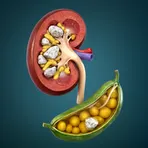
Hard stones form inside an organ like the kidney or gallbladder
Surface Forms
Morphology
nephrolithiasis = nephrolith (opaque) = nephro + lith + iasis
The medical term is not transparent to learners without specialized knowledge.
Etymology
The word nephrolithiasis breaks into clear parts: nephro- means 'kidney', lith- means 'stone', and -iasis means 'a condition'. So, nephrolithiasis literally means 'the condition of kidney stones', which is why it is the medical name for having stones in the kidney.

