
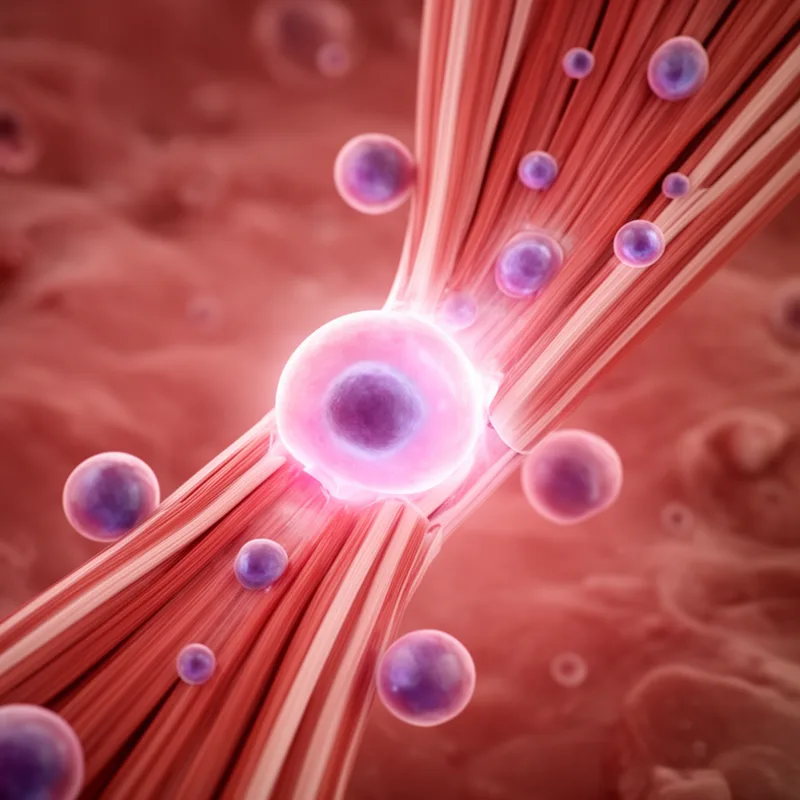
myoblast
 1
9.6

- noun
- /ˈmaɪəˌblæst/
- Specialized
- During muscle regeneration, myoblasts multiply and fuse together to form new muscle fibers.
- myoblast cells
Examples
-
Myogenin is also present but is restricted to more differentiated myoblasts.
Academic text (2004) -
Researchers injected myoblasts into the damaged muscle areas to help rebuild the tissue.
-
Whereas A myoblast can only give rise to another myoblast.
-
So muscle fibers are tubes that have fused myoblasts that join their cytoplasm and have multiple nuclei.
-
Ligament repair involves a variety of factors such as BMP-7, TGF, and PDGF, and cells including fibroblasts and myoblasts.
Academic text (2018) -
The myoblasts are important because they develop into muscle tissue during the growth process.
How Mature

Surface Forms
Morphology
myoblast = blast (opaque) = myo + blast
Both elements are technical combining forms (myo- 'muscle' and -blast 'immature cell'); an average B1 learner cannot reliably derive the biomedical meaning.
Etymology
The word myoblast comes from the Greek root myo- meaning 'muscle' and the part -blast meaning 'young cell' or 'sprout', so a myoblast is a young cell that will grow into muscle.