
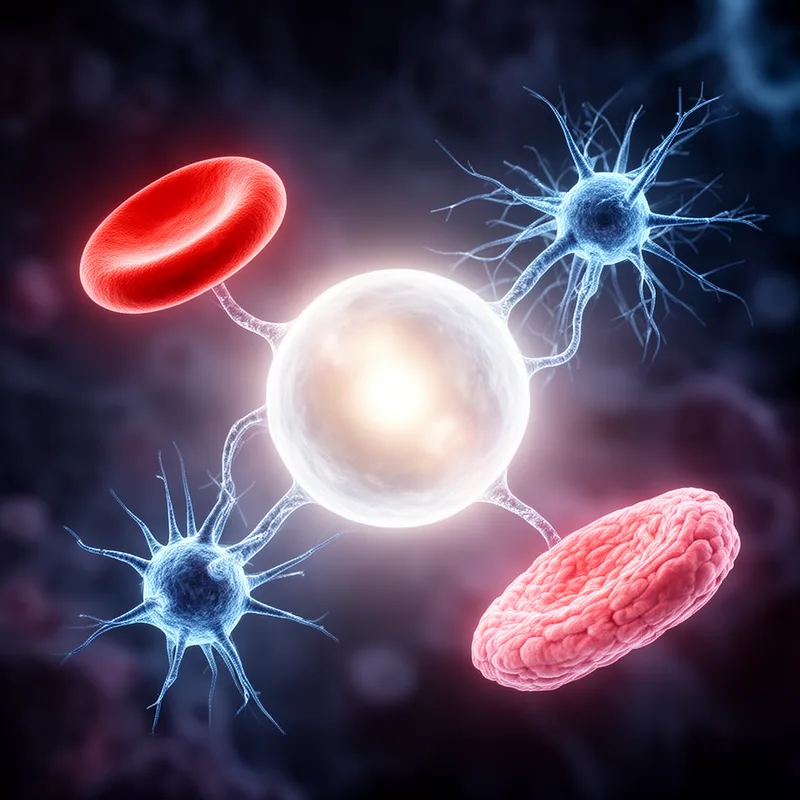
stem cell
 77
4.1
77
4.1

- noun
- /stɛm sɛl/
- Specialized
- So this allows us to create stem cells from every individual.
- embryonic stem cells
- stem cell research
- stem cell therapy
Loading YouTube…
Watch on YouTubeThat started the field really of using stem cells to build organs.
- That started the field really of using stem cells to build organs.
- We know that stem cells do form in the adult brain.
- It turns out that we always have stem cells in our body.
- So most people have heard of stem cell transplants.
- We've been able to get programmed stem cell differentiation to work.
- Later on, the stem cells get more specialised.
- This is where intestinal stem cells inside your gut start to be produced.
- EPC's as stem cells can also turn into brain cells.
- Second, fresh embryonic stem cells are just hard to come by.
- So month three, they were in the hospital was when Azalea had a stem cell, stem cell transplant.
- It also increases stem cell production and it promotes healing.
- PRP less so, but certainly stem cells and peptides.
- So first, the stem cells in our brain.
- And I've gotten stem cell twice since then with them CPI.
Examples
-
Researchers are studying how stem cells can be used to regenerate damaged tissues.
-
Arthritis is a disease that might be treated using regeneration through stem cell injections.
Academic text (2012) -
So there are stem cells in places like the brain.
-
We know that we have a new class of stem cells has just been discovered.
-
The stem cell treatment was a complete success.
-
We know that stem cells do form in the adult brain.
-
That started the field really of using stem cells to build organs.
-
Today, skin is grown in a lab using skin and stem cells taken from the body.
Academic text (2012) -
One other way to obtain stem cells is to use the adult stem cells that exist throughout our bodies.
Academic text (2012) -
It turns out that we always have stem cells in our body.
How Potent
- Specialized

- Specialized
1
8.9
- Specialized
77
4.1
- Specialized

 1
9.5
1
9.5
Surface Forms
Morphology
Although the parts 'stem' and 'cell' are familiar, the compound is a specialized biomedical term whose full sense (undifferentiated cell with self‑renewal and differentiation potential) is not directly predictable from 'stem' as a plant stalk and 'cell' as a microscopic unit. There is a loose metaphorical link (stem = source/origin) that might lead learners to guess it denotes a source cell, but the technical properties require prior exposure, so it is only partially transparent.
Etymology
Stem cell comes from the picture of a plant stem that stays simple but can grow into many branches and leaves. That's why a stem cell means a cell that can 'change into different types' of body cells and can 'make more of itself'.