
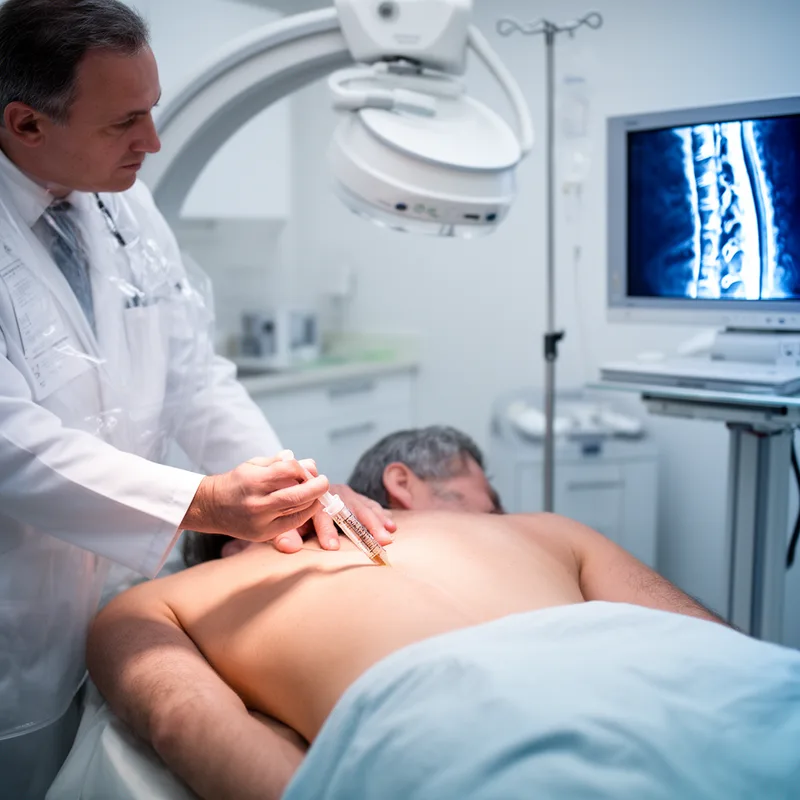
myelography


 1
9.9
- noun
- /ˌmaɪəˈlɒɡrəfi/
- Specialized
- Myelography is used to examine the spinal cord, nerve root bundles, and possible intrusion of the vertebral disk into the spinal canal.
Examples
-
The myelography revealed that the patient's spinal cord was compressed due to a herniated disc.
-
There was evidence of spinal cord compression in the eleven patients who had CT myelography.
Academic text (2007) -
He was also told that the seizure could have resulted from natural causes, and the spinal diseases were normal complications from the myelography procedure.
Blog text (17) -
Plain radiography and computerized tomography scan combined with contrast myelography.
Academic text (2007) -
Myelography may show the relationship of bony to neural elements (Eisenberg & Johnson, 2003).
Academic text (2006) -
There was extensive vertebral body destruction and spinal cord compression on CT myelography (Fig. 4).
Academic text (2007) -
Computed tomography is most useful for imaging small bony structures and, when coupled with myelography, can demonstrate soft tissue abnormalities in the spinal canal.
Academic text (2006) -
There are general guidelines for the assessment of prognosis and to decide whether it is appropriate to carry out more in-depth diagnostic methods (Rx, myelography, CT, MRI).
Blog text (26) -
Early latency brainstem audiometry and Panopaque myelography of the posterior fossa confirmed a 2 cm right acoustic neuroma.
Academic text (1995) -
After the myelography, the doctors were able to identify the cause of the patient's back pain.
Surface Forms
Morphology
myelography = myelo + graph + graphy
This is a specialized medical term built from classical combining forms, so its meaning is not readily guessable for an average B1 learner.
Etymology
Myelography comes from myelo- meaning 'spinal cord' and -graphy meaning 'recording' or 'writing', the same -graphy you see in photograph. So myelography literally means 'recording the spinal cord', which fits a medical test that makes X-ray images of the spine.