

mutagenesis
 1
9.9
1
9.9

- noun
- /ˌmjuːtəˈdʒɛnɪsɪs/
- Specialized
- Classical forward genetic approaches, i.e., phenotype-based mutagenesis screens, are easy to perform and universal, provided the species can be cultured and crossed.
- chemical mutagenesis
- site-directed mutagenesis
- in vitro mutagenesis
Examples
-
Treatment with sodium azide: For chemical mutagenesis, a chemical mutagen, sodium azide, was used.
Academic text (2015) -
Researchers are studying the effects of mutagenesis to understand how it can lead to beneficial mutations in crops.
-
And effectively these ends are positions where they randomized and did mutagenesis here.
-
And so they're developing this method, which is called lethal mutagenesis, to apply it for, for example, HIV.
-
Through both mutagenesis and genetic engineering, we hope to increase their ethanol production," says Skory.
Academic text (1996) -
In vitro mutagenesis is an important tool for probing the biology of aging at the molecular level.
Academic text (1992) -
The effect of different doses of gamma irradiation, as well as chemical mutagenesis by sodium azide, was studied.
Academic text (2015) -
Three of the four mutations we identified in Oti-mig-13 were large deletions, including two derived from EMS mutagenesis screens.
Academic text (2017) -
Mutagenesis can occur when organisms are exposed to radiation or certain chemicals that alter their genetic material.
-
The laboratory conducted experiments on mutagenesis to observe how different agents affect the DNA of bacteria.
Antonyms

Compounds
- Specialized
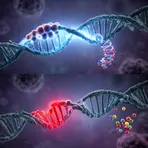
A change in a gene when new DNA inserts and stops it working
How Advanced
- Specialized

 1
7.9
1
7.9

- Specialized
27
4.1
- Specialized
1
9.9
- Specialized
1
6.8
Surface Forms
Morphology
Etymology
Mutagenesis comes from Latin mutare ('to change') and Greek genesis ('creation'), the same root you see in gene and generate. So, mutagenesis is the process that creates changes in genes.