

musk sheep
- noun
- /mʌsk ʃip/
- US
- The musk sheep is well adapted to surviving the harsh winters of the Arctic tundra.
Examples
-
In the wild, the musk sheep defends itself against predators by forming a defensive circle.
-
Researchers observed a musk sheep grazing alongside caribou in northern Canada.
-
The musk sheep is known for its thick fur.
-
Have you ever seen a musk sheep in the wild?
-
Researchers observed a musk sheep grazing alongside caribou in northern Canada.
-
In the wild, the musk sheep defends itself against predators by forming a defensive circle.
-
The musk sheep is well adapted to surviving the harsh winters of the Arctic tundra.
Synonyms
 2
6.0
2
6.0

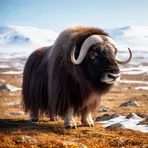
A large shaggy animal like a cow with curved horns that lives in the far north


 1
6.5
1
6.5
A large, shaggy Arctic animal with curved horns and very thick fur

A large shaggy mammal like an ox or sheep that lives in the Arctic tundra, often called the musk ox
Surface Forms
Morphology
The compound clearly signals an animal (sheep) associated with 'musk', so a B1 learner would infer it denotes a kind of animal with a musk-related quality. However, the specific species identity and properties (that it is actually a large shaggy bovid akin to a musk ox rather than a true domestic sheep) are not predictable from the parts, and the noun is somewhat misleading, so full meaning requires prior exposure.
Etymology
Musk sheep comes from two images: the animal gives a strong scent called musk and early visitors thought it looked like a shaggy sheep. That's why the name is used for the big, shaggy Arctic animal today.