

Ovibos moschatus
- noun
- /oʊˈvaɪbəs ˈmɒskətəs/
- Specialized
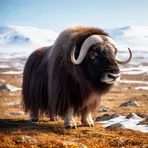
- The Ovibos moschatus is well adapted to surviving harsh Arctic winters.
Examples
-
Scientists observed a herd of Ovibos moschatus grazing on the tundra.
-
The Ovibos moschatus has thick fur that helps it endure the freezing temperatures of the Arctic.
-
Ovibos moschatus populations have stabilized due to conservation efforts.
-
The Ovibos moschatus is well adapted to cold climates.
-
Many tourists visit Canada to see the Ovibos moschatus in its natural habitat.
-
Tourists often travel to see the Ovibos moschatus in the wild, especially during the summer months.
-
Researchers are studying the behavior of the Ovibos moschatus to understand its role in the Arctic ecosystem.
Synonyms
 2
6.0
2
6.0

A large shaggy animal like a cow with curved horns that lives in the far north


 1
6.5
1
6.5
A large, shaggy Arctic animal with curved horns and very thick fur

A large animal with thick fur like an ox that lives in the Arctic
Surface Forms
Morphology
Ovibos + moschatus
This is a scientific Latin binomial (a taxonomic name), not a compositional English phrase; the meaning 'musk ox' cannot be derived by combining the literal senses of 'Ovibos' and 'moschatus', especially since 'moschatus' is not a common English word and lacks a dictionary gloss here. Proper names and scientific names are language-specific conventions and are therefore unpredictable for a B1 learner even if they 'know' the constituent forms.
Etymology
Ovibos moschatus may come from two old words that make a clear picture: Ovibos joins ovis ('sheep') and bos ('ox') to mean 'sheep-ox', and moschatus refers to a 'musk' smell from the males. So the name helps you remember this big, shaggy animal that looks like a mix of sheep and ox and can give off a strong scent.