
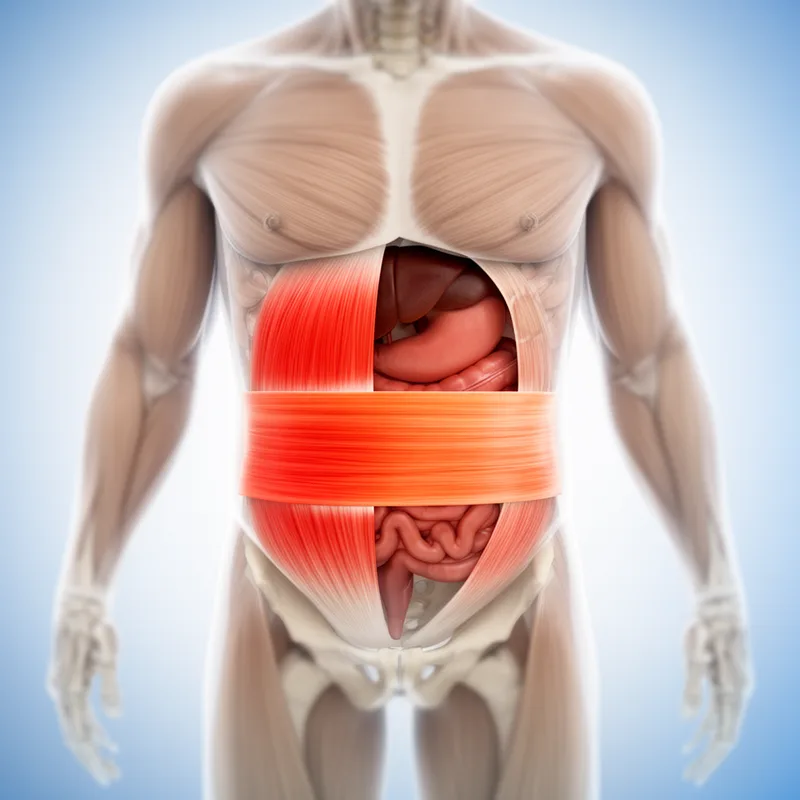
musculus transversalis abdominis
- noun
- /ˈmʌskjʊləs trænsˈvɜrsəlɪs æbˈdɒmɪnɪs/
- Specialized
- The musculus transversalis abdominis lies deep to the internal oblique muscle in the abdominal wall.
Examples
-
Proper strengthening of the musculus transversalis abdominis can help improve core stability.
-
In abdominal surgery, the musculus transversalis abdominis is often encountered while creating an incision.
-
The musculus transversalis abdominis plays a crucial role in core stability.
-
Strengthening the musculi transversales abdominis can improve posture.
-
During physical therapy, I learned how to engage my musculus transversalis abdominis for better posture.
-
The musculus transversalis abdominis contributes to the stability of the spine during movement.
-
Anatomy students need to study the musculus transversalis abdominis to understand its function in the abdominal cavity.
Synonyms

A flat muscle that runs across the front and side of the abdomen and helps keep the body stable

A flat muscle with fibers that run across the belly to make the front and side walls

A flat deep stomach muscle that helps keep the middle of the body stable
Surface Forms
Morphology
musculus + transversalis + abdominis
The term is a compositional Latin anatomical name: musculus (muscle) + transversalis (transverse) + abdominis (of the abdomen), so its meaning 'transverse abdominal muscle' is directly derivable from the parts. Anatomical Latin is systematically built and similar across languages, so a learner who knows the constituent elements would readily infer the overall meaning.
Etymology
Musculus transversalis abdominis comes from old Latin words: musculus meant 'little mouse' because a moving muscle looked like a small mouse under the skin, transversalis meant 'across', and abdominis meant 'belly'. So the name gives the picture of a thin muscle running across your belly, which helps you remember it is the deep abdominal muscle.

