
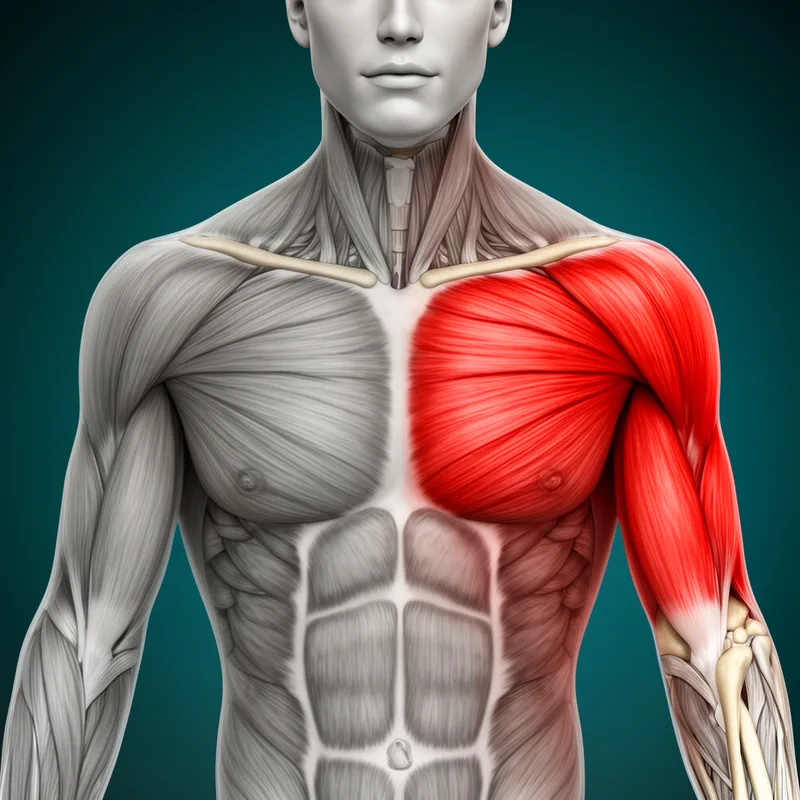
musculus pectoralis
- noun
- /ˈmʌskjələs pɛkˈtɔrəlɪs/
- Specialized
- Damage to the musculus pectoralis can significantly limit arm movement.
Examples
-
The surgeon carefully examined the patient's musculus pectoralis before proceeding with the operation.
-
Anatomy students must learn to identify the musculus pectoralis on cadavers.
-
The musculus pectoralis is essential for arm movement.
-
Many athletes train their musculi pectorales to improve performance.
-
Anatomy students must learn to identify the musculus pectoralis on cadavers.
-
Damage to the musculus pectoralis can significantly limit arm movement.
-
The surgeon carefully examined the patient's musculus pectoralis before proceeding with the operation.
Synonyms

 3
6.4
3
6.4

One of the two large front chest muscles that move the arm
 2
3.9
2
3.9
A large chest muscle that helps move the shoulder and upper arm
 2
7.2
2
7.2
A large chest muscle on each side that helps move the shoulder and upper arm
 1
6.5
1
6.5
Muscles on each side of the chest that help move the arms

A large chest muscle that helps move the arm toward the body and turn it

A large chest muscle that pulls the arm toward the body and turns it inward

A large chest muscle that pulls the arm toward the body and turns it inward
Surface Forms
Morphology
The compound is literally built from 'musculus' (muscle) + 'pectoralis' (chest-related), so its meaning 'chest muscle' or the pectoral muscle is directly derivable from the constituents. This follows regular anatomical Latin compounding and would be immediately comprehensible to a learner who knows both parts.
Etymology
The noun musculus pectoralis may come from Latin: musculus means 'little mouse' and pectoralis means 'chest', because people long ago thought the muscle moving under the skin looked like a little mouse. So the name today refers to the large muscle on the chest.