
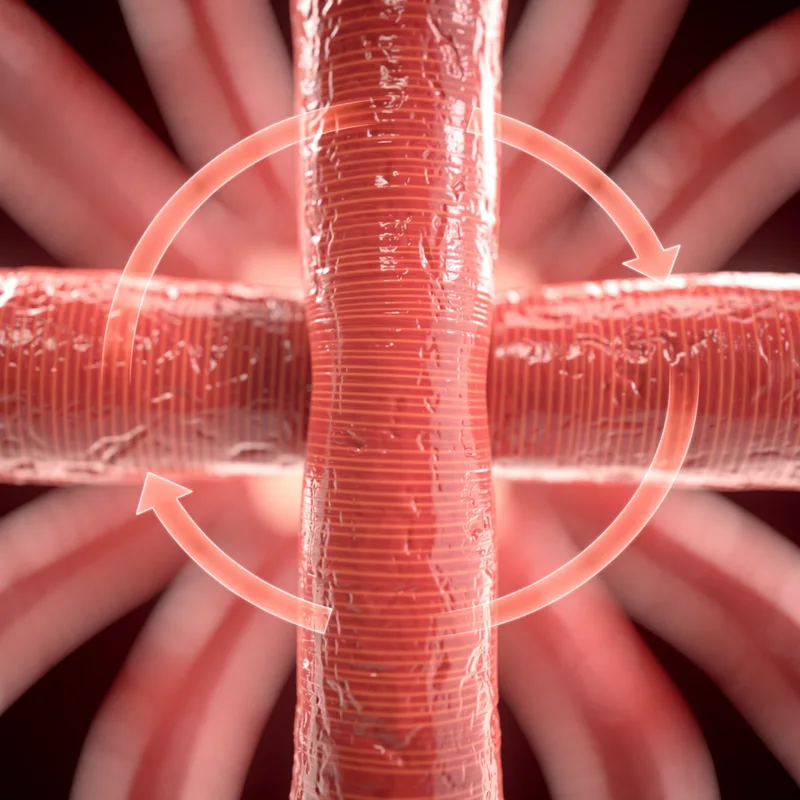
muscle cell
 3
3.0
3
3.0

- noun
- /ˈmʌsəl sɛl/
- Specialized
- Researchers discovered that muscle cells adapt to resistance training by increasing in size and strength.
- smooth muscle cells
- vascular smooth muscle cells
- muscle cell differentiation
Loading YouTube…
Watch on YouTubeWhen you have fat inside the muscle cell, that signal gets broken.
- When you have fat inside the muscle cell, that signal gets broken.
- You can tell a nerve cell from a muscle cell.
- Now atrophy is decrease in muscle cell size, right, or decrease in cell size, if you will.
- Muscle hypertrophy mostly relies on the increasing the size of muscle cells, which depends on increasing protein synthesis.
- A fibroid in your uterine wall is just a conglomeration of poorly formed muscle cells.
- They are the processes that cause different genes to be turned on and off in different cell types so that muscle cells are different from nerve cells.
- And so your, your, your muscle cells shift to using glucose as a source of energy through glycolysis.
- The sirtuins are controlling keeping your muscle cell and muscle cell, keeping your skin cell a skin cell.
- So we work with people with strokes, Tbis, muscle cell injuries.
- That is the largest cell in your entire body of any kind, fat cell, muscle cell, nerve cell, etcetera.
- OK, What happens is in dish one, I get muscle cells.
Examples
-
But when you depolarize a muscle cell, it contracts.
-
If you exercise them, heart muscle cells might get bigger, but few or no new ones will be made.
Academic text (2008) -
When you have fat inside the muscle cell, that signal gets broken.
-
Now in the heart, action potential is moving from one heart muscle cell to another over the surface of the heart.
-
But muscle cells do have an action potential mechanism.
-
In nerve cells, sodium allows messages to be sent, and in muscle cells, it allows muscles to contract.
Academic text (2012) -
Muscle hypertrophy mostly relies on the increasing the size of muscle cells, which depends on increasing protein synthesis.
-
Muscle cells require an exquisite milieu to provide the metabolic needs demanded of the body.
Academic text (2005) -
So, this sugar builds up in the muscle cells, especially in the heart, the skeletal muscles, the diaphragm, which is why they have a hard time breathing.
-
To generate force, muscle cells contract and relax in a coordinated manner during physical activity.
Synonyms
 4
3.4
4
3.4
A long cell in the body that gets shorter to make the body move
 2
8.0
2
8.0
A muscle cell that contracts to make parts of the body move
How Automatic

Surface Forms
Morphology
The term is transparently compositional: 'muscle' (tissue that produces movement) modifies 'cell' (a microscopic living unit), so a 'muscle cell' is readily understood as a cell that makes up muscle and contracts to produce movement. Noun–noun compounding of this kind is a regular, cross-linguistic pattern, so an average B1 learner who knows both words can infer the meaning.
Etymology
The compound muscle cell comes from two simple images: muscle, a word people long ago thought looked like a 'little mouse' moving under the skin, and cell, a word for a 'small room' or tiny part. So muscle cell means one of the tiny parts that can tighten and make a muscle move.