
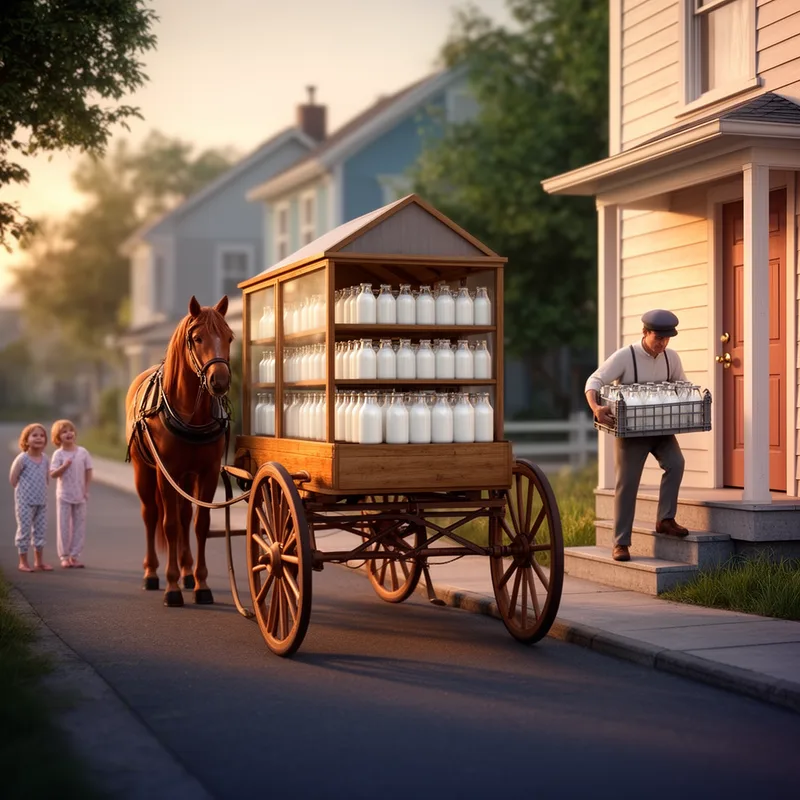
milk wagon
- noun
- /mɪlk ˈwæɡən/
- Archaic
- Children eagerly waited for the milk wagon to arrive, hoping for a free taste of the creamy milk.
Examples
-
Do you really think I'll negotiate with a certified public accountant, a gas meter man, and the... what do you do, you drive a milk wagon?
-
She holds her hand out as she walks slowly toward the milk wagon.
Fiction book (2002) -
A milk wagon rattles its way off the bridge and passes us.
Fiction book (1992) -
The bridge he was crossing was wide enough to bear four traffic lanes, not just one hobbling milk wagon.
Fiction book (1990) -
In private life, he's a milk wagon driver with three children and a kitchen garden and a tendency to... a tendency towards asthma.
-
You can't make a leopard change its spots, or hitch a fire horse to a milk wagon.
-
The milk was fresh, delivered daily by the local milk wagon that trundled down our street.
-
Every morning, the familiar sound of the milk wagon could be heard as it made its rounds through the neighborhood.
Synonyms
 1
2.7
1
2.7

A heavy cart pulled by a horse to carry goods or farm items


 1
9.3
1
9.3
A wagon that used to deliver milk to people's homes
 1
6.5
1
6.5
A train that carries fresh milk from farms to cities

A large cart pulled by a horse that carries goods or people
Surface Forms
Morphology
The compound 'milk wagon' is directly compositional: it denotes a wagon used for carrying or delivering milk, which a B1 learner who knows 'milk' and 'wagon' can readily infer. The noun–noun modifier pattern indicating purpose or contents is common across languages, so the meaning is immediately transparent from the constituents.
Etymology
Milk wagon comes from the horse-drawn carts that used to carry fresh milk in a wagon to people's homes early in the morning. Because these wagons 'delivered milk' door to door, the term now means a vehicle used to bring milk to homes or shops.