

milk cow
 3
1.0
3
1.0

- noun
- /mɪlk kaʊ/
- Many families in the countryside rely on a milk cow for their daily supply of milk.
- farms with milk cows
- Amish farms have milk cows
Examples
-
In 1992, there were 9.5 million milk cows in the country.
Academic text (2000) -
Maybe next year he would get another milk cow.
Fiction book (1995) -
We are talking about my new milk cow.
-
A couple of milk cows were out there too.
Fiction book (1997) -
Otherwise, some of these settler's milk cows are going to disappear.
-
The number of farms with milk cows in the United States has been declining steadily.
Academic text (2006) -
Country folk rely on their animals, be they cow dogs, horses, or milk cows.
Blog text (5) -
In 1997, there were 2,250 dairy farms with more than 500 milk cows, accounting for 27 percent of the dairy cows in the country.
Academic text (2000) -
In 1999, 79.0 percent of California's milk cows were in herds of 500 or more, compared with 4-5 percent of Wisconsin's cows.
Academic text (2001) -
In 1997, Wisconsin enumerated 39,593 farms having cattle and calves but only 22,576 with milk cows (NASS 1999).
Academic text (2001)
Synonyms
 5
1.5
5
1.5
A cow that is kept mainly to give milk


 1
3.2
1
3.2
A cow that people keep and raise to produce milk
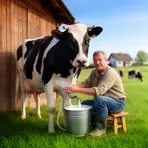
A cow that a farmer keeps to give milk

A cow or other cattle kept to give milk
Surface Forms
Morphology
The noun is a transparent attributive compound: 'milk' (what the cow produces) modifies 'cow', so a B1 learner who knows both words can readily infer a cow kept for milk production. This compositional pattern (e.g. 'dairy cow', 'milking cow') is common and cross-linguistically familiar, making the meaning predictable from the constituents.
Etymology
The compound noun milk cow comes from farm life: farmers kept a cow to give milk, often milking it into a bucket. So, the name points to the animal's job and today means 'a cow kept for producing milk'.