

dairy cow
 5
1.5
5
1.5

- noun
- /ˈdɛəri kaʊ/
- Farmers in the region raise dairy cows to produce milk for local markets.
- dairy cow feed
- milk production per dairy cow
- farm's dairy cows
Loading YouTube…
Watch on YouTubeBut and he noticed that the dairy cows that were eating kelp, some were, some weren't produced more milk.
- But and he noticed that the dairy cows that were eating kelp, some were, some weren't produced more milk.
Examples
-
Most of the crops are used to feed their 620 dairy cows.
Academic text (2000) -
Nevertheless, farmers with fewer than 100 cows still milk 28.9 percent of the nation's dairy cows.
Academic text (2006) -
The count of dairy cows came up one short.
Fiction book (1997) -
Dairy cows must consume large quantities of water for the production of milk.
Academic text (2015) -
In Pennsylvania, she says, "10 to 15 percent of farmers are now grazing dairy cows to some degree."
Academic text (2004) -
Interest has also grown in the potential effects of DCAD on lactating dairy cows.
Academic text (2018) -
Furthermore, nearly a third of the non-Amish counties had either no dairy cows or no herds with as many as ten cows.
Academic text (2006) -
Although dairy cows don't usually graze in pastures of tall grass, those that do often produce less milk.
Academic text (2000) -
Although nearly three-quarters of Wisconsin's farmers had dairy cows in 1964, only one-quarter did in 2000.
Academic text (2001) -
We owned horses, dairy cows, goats, a few sheep, chickens, guinea fowl, geese, and semi-tame mallard ducks.
Fiction book (2001)
Synonyms
 665
1.0
665
1.0
An adult female farm animal that gives milk
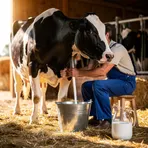 3
1.0
3
1.0
A cow kept to give milk for people to drink


 1
3.2
1
3.2
A cow that people keep and raise to produce milk
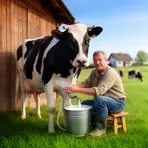
A cow that a farmer keeps to give milk

A cow or other cattle kept to give milk
How Improved

Surface Forms
Morphology
The meaning 'a cow kept for milk production' is directly and transparently derived from combining 'dairy' (relating to milk/ milk-processing) with 'cow' (an adult female bovine). This is a straightforward noun–noun compound following common compositional patterns found across languages, so a B1 learner who knows both words will readily infer the intended meaning.
Etymology
Dairy cow comes from the words dairy (a place where milk is kept or made) and cow (the animal). Farmers used this clear label to show the animal was 'kept mainly for milk', so today dairy cow means a cow raised for its milk.