

micrometeorite
 1
9.5
1
9.5

- noun
- /ˌmaɪkroʊˈmiːtəˌraɪt/
- Specialized
- Researchers found that the micrometeorite contained tiny particles of organic material from space.
Examples
-
Most micrometeorites are only a few hundred micrometers across, about the diameter of a human hair.
Academic text (2001) -
The micrometeorites that land in our everyday environment are irretrievably lost among tiny particles of terrestrial dirt.
Academic text (2001) -
From there, micrometeorites can take weeks before they finally settle to the surface.
Academic text (2001) -
As a result, micrometeorites spend a lot of time near the ocean's surface.
Academic text (2001) -
Carbon makes up almost half of the mass of some of the smallest micrometeorites.
Academic text (2001) -
The lacy, light-colored material in this micrometeorite is rich in carbon.
Academic text (2001) -
The Antarctic and Greenland ice sheets are also prime real estate for micrometeorites because they are far from exposed ground.
Academic text (2001) -
Some micrometeorites also contain a lot of carbon in various forms, including graphite, microscopic diamonds, and organic compounds.
Academic text (2001) -
While micrometeorites and beach sand both contain silicates (minerals common in Earth's crust), micrometeorites contain elements and minerals that completely distinguish them from plain old dirt.
Academic text (2001) -
During the expedition, the team collected samples of micrometeorites that had landed in the Arctic ice.
Synonyms

 1
9.8
1
9.8
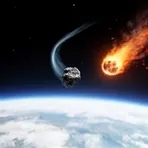
A very small space rock that reaches Earth without burning
 1
9.9
1
9.9
A very small rock from space that can hit Earth or a spacecraft
How Big
- Archaic

- Specialized
1
9.5
Surface Forms
Morphology
Etymology
The word micrometeorite starts with micro- meaning 'small', has meteor meaning 'a falling object from the sky', and the ending -ite is used for rocks, as in meteorite. So, a micrometeorite is a very small rock from space that reaches Earth.