

meteorite
 62
6.7
62
6.7

- noun
- /ˈmiːtiəraɪt/
- Specialized
- Still, the majority of stony meteorites are cool to the touch when recovered.
- types of meteorites
- iron meteorites
- stony meteorites
Loading YouTube…
Watch on YouTubeThey can come from comets and and meteorites that bring water to the surface of the moon.
- They can come from comets and and meteorites that bring water to the surface of the moon.
- It's plausible because these molecules have indeed been found on meteorites.
- Compare that to this little sample over here, which is a Martian meteorite.
- So is there a way to verify that a, a, a, a meteorite you might have is definitely from the moon?
- Therefore, the meteorite must have landed somewhere on some sort of continent or land.
- So if a meteorite happens to kill my wife,
- They look a little bit like the girl and meteorite things.
- So that kind of graph determined that Marshall meteorites are for Mars.
Examples
-
So this happens when a meteorite hits the ground and it creates glass, basically.
-
Therefore, the meteorite must have landed somewhere on some sort of continent or land.
-
Sometimes a museum will buy the meteorite and whatever it hit for display.
Fiction book (2001) -
This was a little meteorite that came from Mars.
-
Then it dawned on him that the meteorite was heading in his general direction.
Fiction book (2001) -
And statistically, one person somewhere in the world could be struck by a meteorite every nine years.
Academic text (1992) -
The approximate path of the meteorite is shown by the arrow.
Academic text (1992) -
The relatively rare stony iron meteorites consist of roughly equal amounts of rock and iron.
Academic text (1992) -
About 3% of meteorites are iron meteorites, which are, not surprisingly, mostly iron, with some nickel.
Academic text (1992) -
A fascinating meteorite landed in our backyard last night, leaving a crater in the ground.
Synonyms
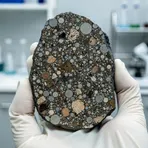 2
9.9
2
9.9
A rock from space that has small round mineral grains you can see
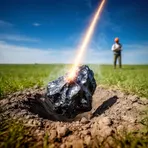 1
9.9
1
9.9
A rock or metal piece from space that falls to Earth
 1
9.5
1
9.5
A tiny piece of rock from space that reaches the ground without burning up
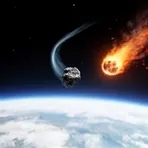

 1
9.8
1
9.8
A very small space rock that reaches Earth without burning

A stone from space that falls to Earth

A stone from space that fell to Earth and is made mostly of rock minerals

A stony meteorite without small round grains that formed when its asteroid or planet melted

A stony meteorite made mostly of volcanic rock, often from the asteroid Vesta
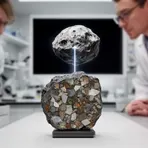
A stony meteorite made of mixed rock pieces from asteroid 4 Vesta
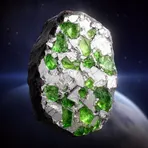
A space rock with green crystals set in shiny metal
How Big
- Specialized
62
6.7

- Specialized
300
4.1
- Specialized
3
8.5
- Specialized
1
9.8
- Specialized
1
6.3
Surface Forms
Morphology
Etymology
The word meteorite comes from the Greek root meteor meaning 'high in the air' and the ending -ite that names stones. So a meteorite is a 'stone from the sky', which is why it is a rock that fell to Earth.