
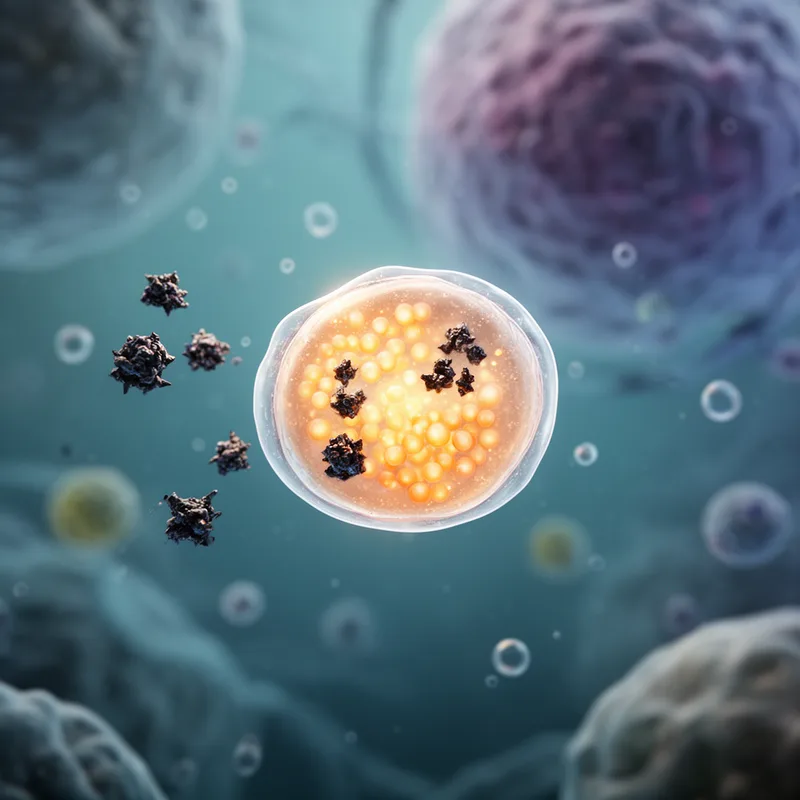
microbody
- noun
- /ˈmaɪkroʊˌbɑdi/
- Specialized
- To the known functions of microbodies, we can thus add the control of mitochondrial and plastid division, at least in certain organisms.
Examples
-
Following nuclear division, the microbody divides completely to form two daughter microbodies, and cytokinesis occurs (Figure 3aV, aVI).
Academic text (1996) -
We also examined whether actin is contained in the MD- and PD-rings and the microbody in C. merolae.
Academic text (1996) -
The MD-ring disappears, as if the materials of the MD-ring are converted into the dividing elongated microbody.
Academic text (1996) -
An association between the PD-ring and microbodies has also been observed in the algae (Kuroiwa 1991).
Academic text (1996) -
Following nuclear division, the microbody divides completely to form two daughter microbodies, and cytokinesis occurs (Figure 3aV, aVI).
Academic text (1996) -
The spherical microbody begins to elongate along the MD-ring, and the end of the microbody is associated with the PD-ring (Figure 3aIII).
Academic text (1996) -
The spherical microbody begins to elongate along the MD-ring, and the end of the microbody is associated with the PD-ring (Figure 3aIII).
Academic text (1996) -
Each microbody in the cell plays a unique role in metabolism and cellular processes.
-
Researchers found that the small microbody helps in breaking down fatty acids within the cell.
-
The plant cell's microbody is essential for the detoxification of hydrogen peroxide.
Synonyms

 3
5.6
3
5.6

A small part inside a cell that has one job
A small part inside a cell that has one job, for example making energy
Surface Forms
Morphology
Etymology
Microbody comes from the Greek micro- meaning 'small' and the English word body meaning 'a part'. So a microbody is a 'small body' inside a cell that does a specific job.