

methylene blue


 1
6.4
1
6.4
- noun
- /ˈmɛθəˌlin blu/
- Specialized
- I did vitamin IV such as silver, ozone, methylene blue in a Myers cocktail which is vitamin CB, vitamins and glutathione.
Loading YouTube…
Watch on YouTubeSo if I do red light therapy with methylene blue, I'm exponentially increasing.
- So if I do red light therapy with methylene blue, I'm exponentially increasing.
- At that time, I hit her with more methylene blue than any patient I've ever done in my entire career.
- I did vitamin IV such as silver, ozone, methylene blue in a Myers cocktail which is vitamin CB, vitamins and glutathione.
Examples
-
To observe the cell structure under a microscope, we prepared a slide with methylene blue.
-
So if I do red light therapy with methylene blue, I'm exponentially increasing.
-
The ovarian tissue was treated with several drops of methylene blue solution, then flushed with water.
Academic text (1990) -
This can be accomplished with intubation or injection of methylene blue dye.
Academic text (2006) -
In the laboratory, methylene blue is commonly used as a dye for staining samples.
-
The doctor administered methylene blue as an antidote for the patient's cyanide poisoning.
Synonyms
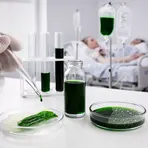
A dark green dye used to stain tissues, show chemical changes, kill germs and treat cyanide poisoning
Surface Forms
Morphology
The compound is compositionally named: 'methylene' (a chemical radical) + 'blue' (a color) clearly signals a blue chemical or dye, so a learner who knows both constituents can infer it is a blue chemical substance. However, the specific biomedical uses (stain, antiseptic, antidote) and the technical sense of 'methylene' are specialized and not predictable from the parts alone, making the term only partially transparent to a B1 learner.
Etymology
Methylene blue gets its name from the chemical part methylene and from its deep blue color; it was first made as a blue dye. That's why methylene blue is used 'to stain' cells in the lab and as a blue 'antidote' or 'medicine' in some treatments.