
mesenchyme


 1
9.9
- noun
- /ˈmɛsənˌkaɪm/
- Specialized
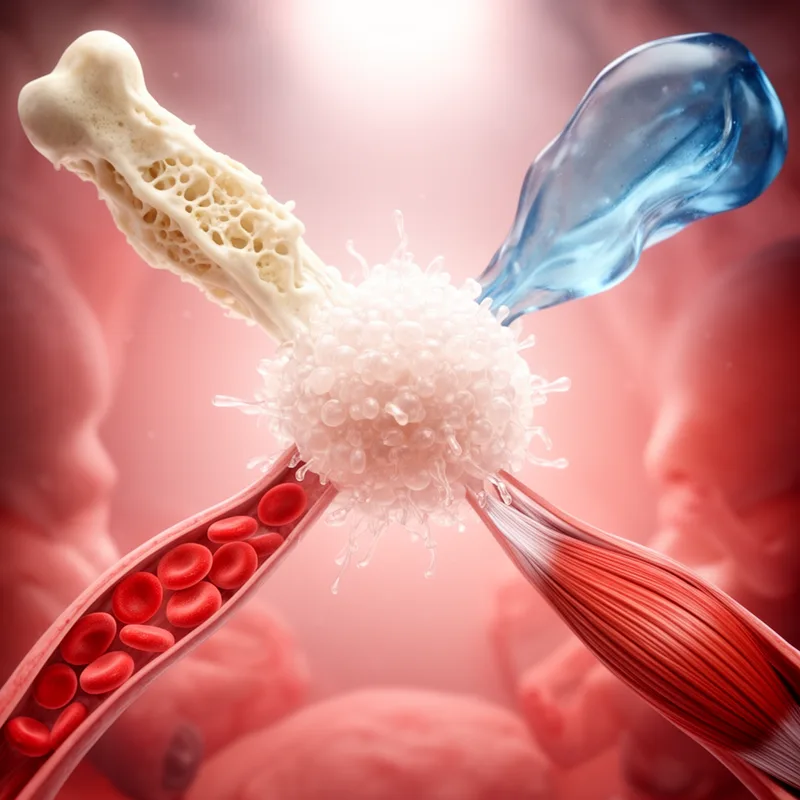
- Mesenchyme gives rise to bone, cartilage, and muscle.
- mesenchyme differentiates
Examples
-
The majority of the skull bones and the clavicle develop through intramembranous ossification, in which the bones are formed directly from an embryonic tissue known as mesenchyme.
Academic text (2006) -
During the embryonic period, the medial portion of the nasal drift passes through the ethmoid region during normal transposition, and a minor part of this mesenchyme differentiates into the periodontal membrane.
Academic text (2006) -
The nerve terminates in mesenchyme.
Academic text (2003) -
The mesenchyme in which they are surrounded is differentiating into connective tissue.
Academic text (2003) -
The caudal main trunk terminates in mesenchyme.
Academic text (2003) -
According to other theories, neuroectoderm differentiates toward mesenchyme.
Academic text (2004) -
Tracheal development begins during the fourth week of life, when the respiratory diverticulum branches off of the foregut mesenchyme.
Academic text (2008) -
The mesenchyme is important because it develops into various connective tissues that support the body's structure.
-
The embryo's mesenchyme transforms into essential parts such as blood and smooth muscles during development.
-
Researchers study mesenchyme to understand how it contributes to forming bones and cartilage in the growing fetus.
Synonyms
 1
5.4
Tissue in an embryo that develops into organs
 1
9.8
The middle layer in a developing animal that becomes muscles, bones, and blood
Middle layer of cells in an embryo that makes muscles, bones, blood, and connective tissue
Surface Forms
Etymology
Mesenchyme comes from Greek parts meso- meaning 'middle' and -enchyme meaning 'poured in' or 'filling'. So, mesenchyme is the 'middle, filling' tissue in an embryo that later becomes connective tissue, blood, and smooth muscle.