
mesoderm


 1
9.8
- noun
- /ˈmɛzəˌdɜrm/
- Specialized
- We found that during morphogenesis, the head mesoderm underlying the cephalic neural crest stiffens.
- mesoderm stiffness
- mesoderm cells
- extension of the mesoderm
Examples
-
Mesoderm layers form inside the embryo or egg where germ cells live.
Academic text (2015) -
Here we just have the ectoderm and the underlying mesoderm, including the notochord.
-
The cells on top of the endoderm form mesoderm and the cells on the outside form the ectoderm.
-
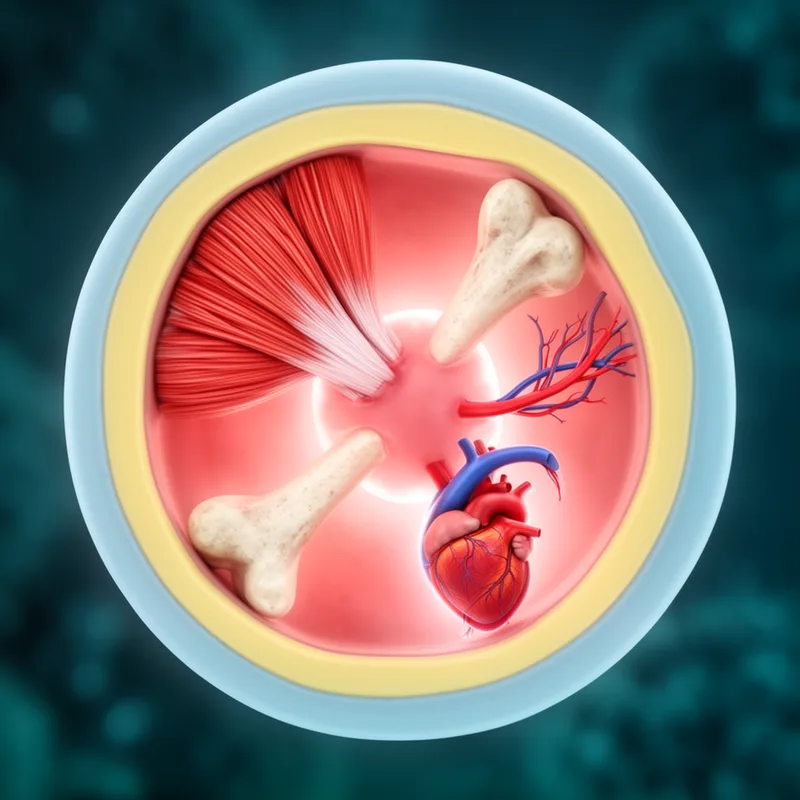
The mesoderm is the middle layer, which differentiates to become the circulatory system, bones, muscles, and connecting tissues.
Academic text (2012) -
In half of these cases, histology revealed squamous epithelium and cartilage with a mixed pattern of ectoderm and mesoderm.
Academic text (1998) -
The mesoderm is the middle layer, which differentiates to become the circulatory system, bones, muscles, and connecting tissues.
-
Some of the most obvious structures derived from the paraxial mesoderm are bones.
-
Mesoderm layers form inside the embryo or egg where germ cells live.
Synonyms
Middle layer of cells in an embryo that makes muscles, bones, blood, and connective tissue
Surface Forms
Morphology
Etymology
The word mesoderm has two parts: meso- meaning 'middle' and -derm meaning 'skin', as in dermis. So it is the 'middle skin' layer in an embryo, which is why it makes muscles, bones, blood and other tissues.