
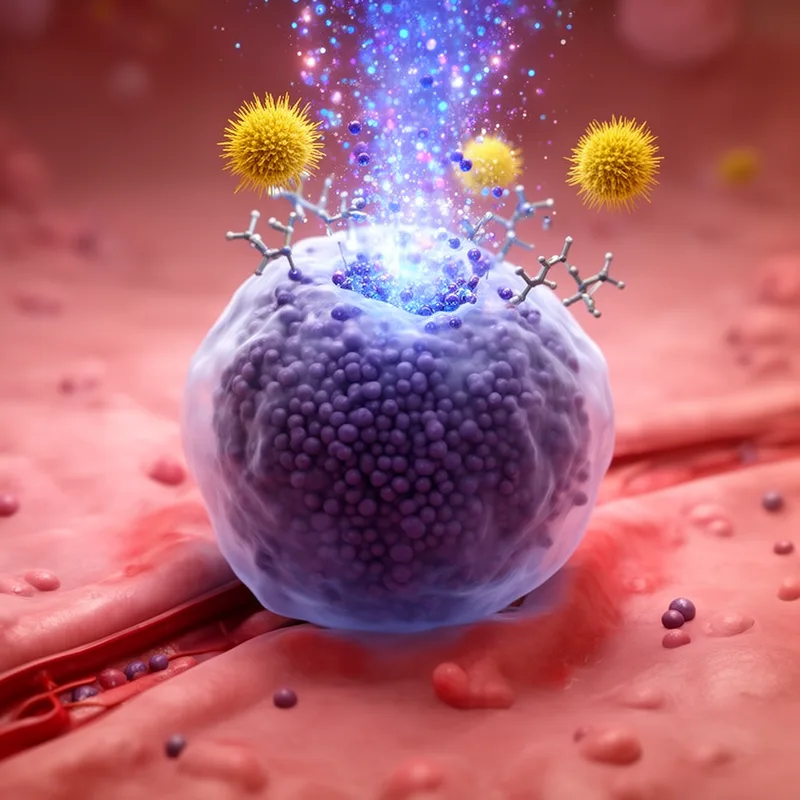
mast cell
 1
5.6
1
5.6

- noun
- /mæst sɛl/
- Specialized
- The main sources of histamine in the skin are mast cells, which both synthesize and store histamine in their glycosaminoglycan granules.
- mast cell degranulation
- histamine release from mast cells
- mast cells release
Loading YouTube…
Watch on YouTubeIt's skin cancer, a mast cell tumor, and he had to get surgery to cut it out fast.
- It's skin cancer, a mast cell tumor, and he had to get surgery to cut it out fast.
Examples
-
These antibodies activate the mast cells and cause the mast cells to release their cell contents, which is histamine.
-
Cells within the dermis include fibroblasts, macrophages, mast cells, and leukocytes.
Academic text (1995) -
In addition, prominent vascularity and many mast cells were seen.
Academic text (2004) -
Mast cells occur in great numbers in the dermis of dialysis patients.
Academic text (1996) -
Allergic rhinitis typically begins with the exposure of IgE-bound mast cells to an allergen and progresses to subsequent mast cell degranulation and histamine release.
Academic text (2005) -
Mast cells play a crucial role in the body's allergic responses by releasing mast cells when triggered.
-
During an allergic reaction, mast cells release chemicals that can lead to symptoms like itching and swelling.
-
In connective tissue, mast cells are responsible for storing and releasing substances such as histamine and heparin.
Synonyms

A large cell in body tissue that releases chemicals like histamine during allergies, causing itching and swelling
A large cell in the body's connective tissue that releases chemicals like histamine, heparin, and serotonin during allergic reactions
Surface Forms
Morphology
mast + cell
Although 'cell' is transparent, the component 'mast' does not convey the biomedical sense (it is a historical/technical label, not the common meaning like a ship's mast), so the combined term refers to a specialized histamine-containing cell rather than a compositional 'mast' + 'cell' meaning. The MWE is a technical, etymologically motivated term whose overall meaning cannot be derived by a B1 learner who only knows the ordinary word meanings.
Etymology
The term mast cell may come from an old German word mast meaning 'to fatten' or 'to feed'. Early scientists saw these cells full of tiny packets and used the image of a cell stuffed with stores, so that's why mast cells are remembered as cells that hold and release chemicals in allergic reactions.