
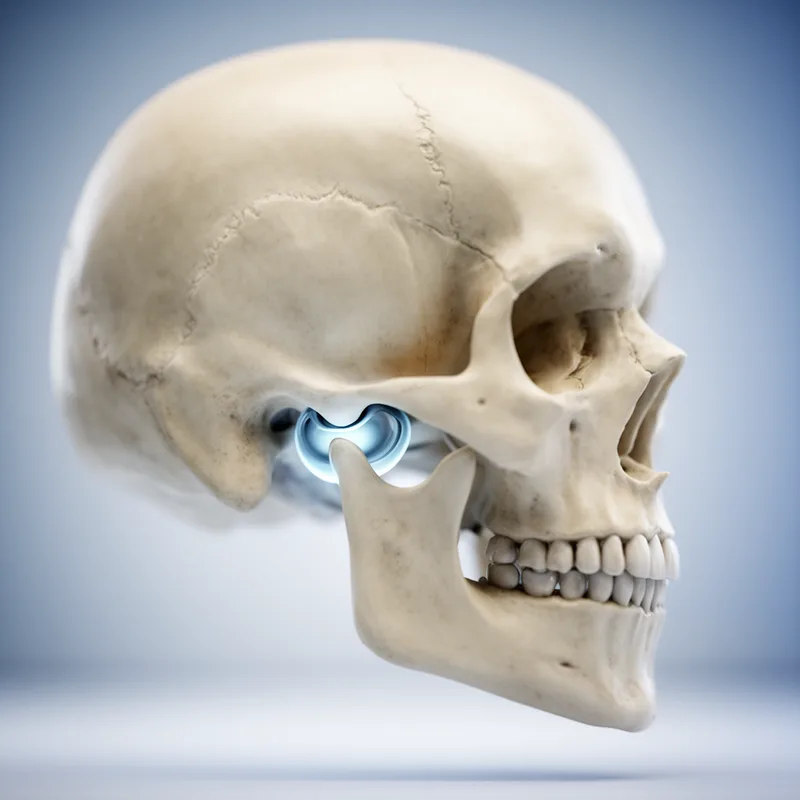
mandibular fossa
- noun
- /mænˈdɪbjʊlər ˈfɑsə/
- Specialized
- The temporomandibular joint is formed where the mandible meets the mandibular fossa of the temporal bone.
Examples
-
Damage to the mandibular fossa can lead to issues with jaw movement and pain.
-
In anatomy, the mandibular fossa is located in the temporal bone.
-
During surgery, care must be taken to avoid damaging the structures near the mandibular fossa.
-
The mandibular fossa is crucial for jaw movement.
-
The temporomandibular joint functions at the mandibular fossa, allowing for smooth jaw movement.
-
In a healthy skull, the mandibular fossa serves as the attachment point for the mandible's condyle.
-
An injury to the mandibular fossa may result in discomfort and restricted motion of the jaw.
Synonyms

A deep hollow in the skull near the ear where the lower jaw fits
Surface Forms
Morphology
The compound is compositionally transparent: 'mandibular' means related to the lower jaw and 'fossa' means a depression in bone, so a learner who knows both terms can infer it is a bone depression associated with the mandible. Although precise anatomical details (which bone or the condyle-fitting function) require specialist knowledge, the basic referent is directly derivable from the constituents.
Etymology
Mandibular fossa gets its name from the words mandible, meaning the lower 'jaw', and fossa, meaning a 'hollow', and it is the hollow in the skull where the lower jaw fits.

