
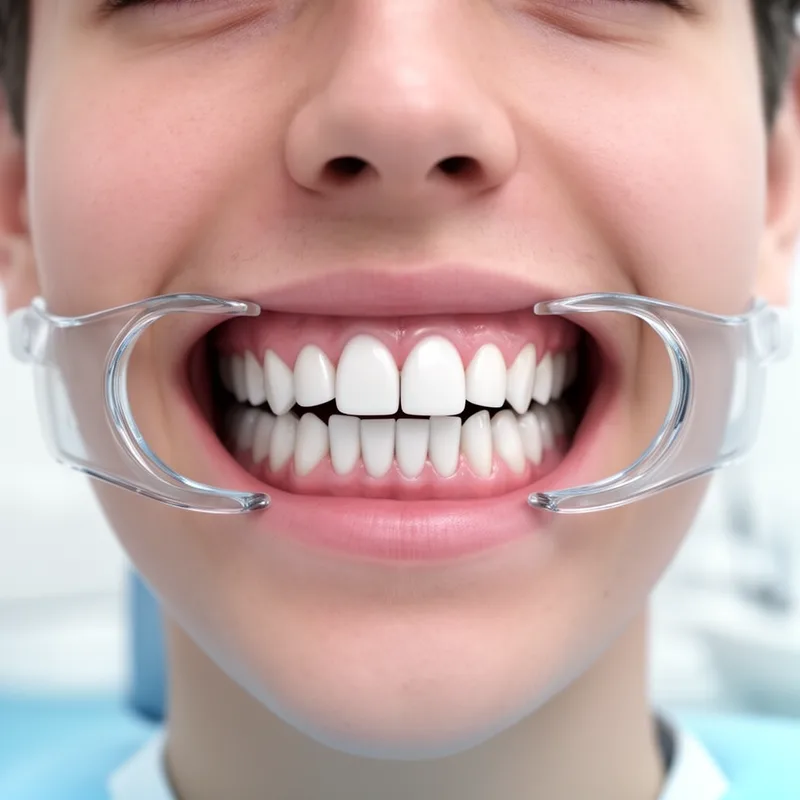
malocclusion


 1
8.3
1
8.3
- noun
- /ˌmæl.əˈkluː.ʒən/
- Specialized
- The dentist explained that malocclusion occurs when the upper and lower teeth do not line up properly.
Examples
-
Symptoms include painful mastication, clicking, trismus, malocclusion, and deep pain in the joint.
Academic text (2003) -
Because anomalies such as missing teeth and/or malocclusion in the children with CLP may have affected the spectral moment data, especially for /t/, two additional analyses were performed to examine this possibility.
Academic text (2012) -
None of the children without CLP had missing teeth or malocclusion.
Academic text (2012) -
Also, really, having a pacifier until 3 years old has not been associated with a significant increase in dental malocclusion.
Blog text (26) -
Malocclusion could be dental or skeletal.
Blog text (16) -
It's a malocclusion type II and usually shows a weak chin and a slight overjet or deep bite in front.
Blog text (16) -
Proceeding from the clinical indications, second and third variants of the device may be applied in the case of malocclusion treatment.
Blog text (1) -
Maxillomandibular advancement has been performed for many years to correct malocclusion in children and young adults, and it is well described in the maxillofacial surgery literature.
Academic text (1999) -
Many children experience malocclusion, which can lead to problems with chewing and speaking.
-
Treatment for malocclusion often involves braces to help align the teeth correctly.
Antonyms
How Aligned
- Specialized

- Specialized
1
8.3
Surface Forms
Morphology
Etymology
Malocclusion combines mal- meaning 'bad', like in malfunction, and occlusion from a root meaning 'to close', like the word close. So a malocclusion is literally a 'bad closing', which in dentistry means the upper and lower teeth do not fit together properly.