

magnetic declination
- noun
- /mæɡˈnɛtɪk dɪˈklɪneɪʃən/
- Specialized
- The magnetic declination at this location is about 5 degrees east of true north.
Examples
-
Navigators must correct for magnetic declination when charting their course.
-
Changes in magnetic declination over time can affect compass readings.
-
The magnetic declination varies by location.
-
Understanding magnetic declination is crucial for accurate navigation.
-
When navigating, it is essential to account for magnetic declination to ensure accurate direction.
-
The magnetic declination varies by location and affects how a compass aligns with true north.
-
Before using the map, we checked the magnetic declination to adjust our compass readings.
Synonyms
 3
7.4
3
7.4

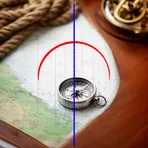
The angle between magnetic north and true north used in navigation

 1
6.8
1
6.8
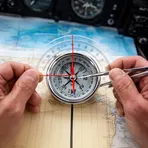
Angle between the north shown by a compass and true north at a place used for navigation
Surface Forms
Morphology
The phrase is compositionally built: 'declination' denotes an angular distance and 'magnetic' specifies that the angle concerns Earth's magnetic field, so a learner who knows both constituents can infer it refers to the angular difference involving magnetic north. Although somewhat technical, the modifier+noun structure is regular and cross-linguistically transparent, so the meaning is derivable from the parts.
Etymology
Magnetic declination comes from the simple image of a compass needle pointing to magnetic north while a map shows true 'north'. The word declination means the small 'tilt' or angle between them, so the term means the angle you must correct for when reading a compass.