
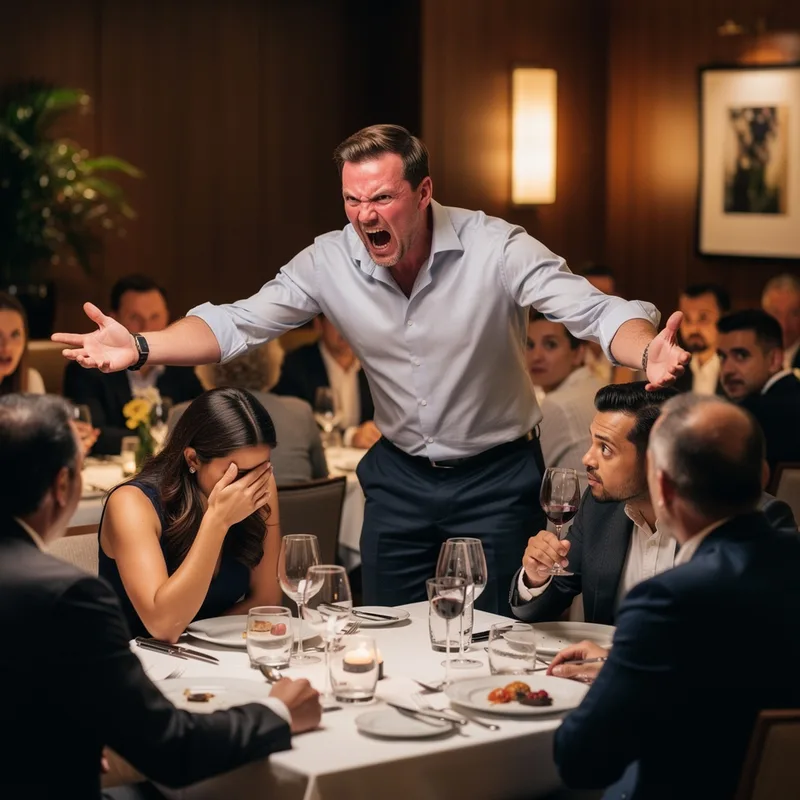
to make a scene
 45
4.9
45
4.9

- phrasal verb
- /meɪk ə siːn/
- Informal
- Meredith said softly, "Please, Reed, don't make a scene here."
- stop making a scene
- please don't make a scene
- want to make a scene
Examples
-
Just please don't make a scene.
-
To the great relief of his family, Victor refrained from making a scene at the police station.
Academic text (2006) -
I suppose I was going to make a scene.
-
And I knew James would make a scene.
-
Look, you were about to make a scene.
-
The last thing I wanted to do was to make a scene, to call attention to myself.
Fiction book (2000) -
Moreover, a good husband and a man of honor do not make a scene with his wife in public.
Academic text (1990) -
Don't argue or make a scene.
-
You don't want to make a scene and spoil everything.
-
It's embarrassing when people make a scene in public over something small.
Synonyms
 32
5.5
32
5.5
Show strong feelings by behaving badly instead of talking
 22
3.0
22
3.0
Complain loudly about something small
 4
6.8
4
6.8
Complain loudly in public to get attention
How Dramatic
12
6.9

- Informal
18
4.4
- Informal
45
4.9
22
3.0
41
3.7
Surface Forms
Morphology
The meaning 'to behave in a loud or noticeable way in public' is directly derivable from combining 'make' (to cause) with 'scene' (a public display of emotion); a learner who knows both constituents can infer that one is 'causing a scene.' This verb + noun causative composition is common cross-linguistically and follows regular English patterns, so it is readily comprehensible to a B1 learner.
Etymology
The phrase make a scene comes from the theatre. On stage, actors make a scene by showing loud, dramatic feelings for the audience, so when someone makes a scene in public they 'behave loudly' to get attention.