
lyase


 1
9.7
- noun
- /ˈlaɪeɪs/
- Specialized
- The biochemical process relies on a specific lyase to convert fats into usable energy.
Examples
-
Researchers studied the lyase that helps in the breakdown of complex sugars into simpler forms.
-
Use ISO citrate lyase to generate glyoxylate.
-
Patients with typical manifestations of CAIS and 17-alpha-hydroxylase/17,20-lyase deficiency were excluded.
Academic text (2018) -
Galeterone is a novel CYP17 lyase inhibitor that is structurally very similar to Abiraterone 117.
Academic text (2017) -
An exploration of the functional significance of several SNPs in the gene for cystathione lyase associated with autistic disorder may shed light on this putative relationship.
Blog text (19) -
In other environments, the limiting nutrient is not that obvious; for example, the acquisition of N-acetylneuraminate lyase probably enables T. vaginalis to scavenge sialic acids from its host for nutrition 117.
Academic text (2018) -
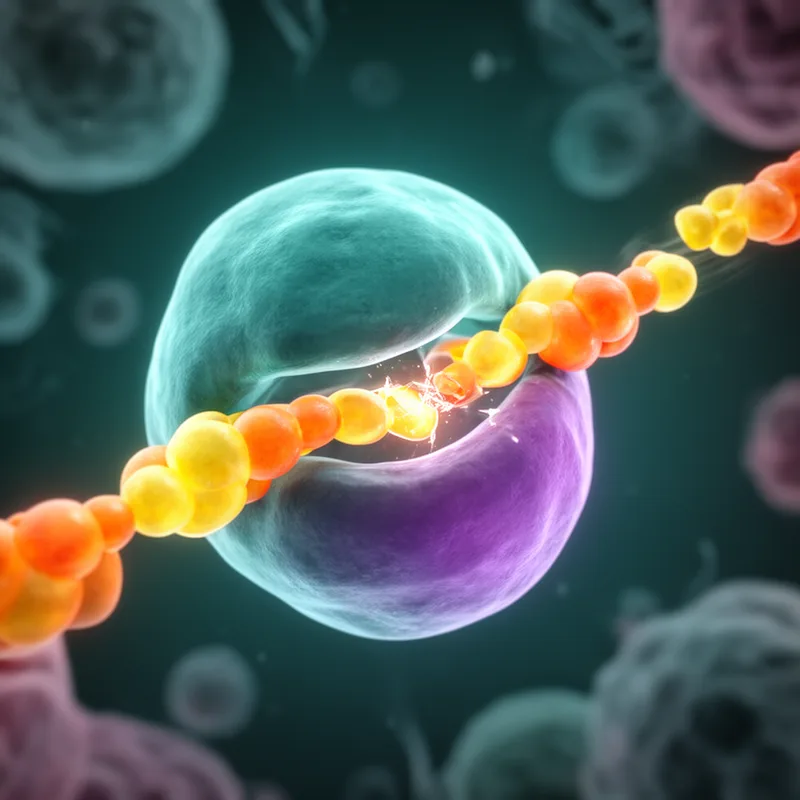
The enzyme lyase catalyzes the cleavage of bonds in substrates without the involvement of water.
Surface Forms
Morphology
lyase = lysis (semi-transparent) = ly + ase
The suffix '-ase' clearly signals an enzyme (transparent), but the root 'ly-'/ 'lys-' is a technical combining form meaning 'break/loosen' that is not obvious to an average learner.
Etymology
Lyase comes from an old Greek root lysis, meaning 'to loosen' or 'to break', plus the enzyme ending -ase. So a lyase is an enzyme that 'breaks' chemical bonds without using water or oxygen.