

lunar caustic
- noun
- /ˈluːnər ˈkɔːstɪk/
- Archaic
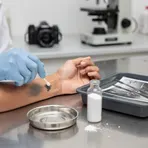
- Before antibiotics, doctors would sometimes use lunar caustic to treat wounds or remove growths.
Examples
-
The doctor used lunar caustic to treat the patient's wound.
-
The pharmacist prepared a stick of lunar caustic for the physician's bag.
-
Although lunar caustic is rarely used today, it once played a key role in minor surgical procedures.
-
Have you ever heard of lunar caustics in medical treatments?
-
Doctors would apply lunar caustic to remove warts during minor surgical procedures.
-
In the past, lunar caustic was commonly used as a cauterizing agent for treating injuries.
-
The nurse handed the surgeon a stick of lunar caustic before the operation began.
Synonyms
 2
5.3
2
5.3

A white chemical used in photography and to stop wound infection
Surface Forms
Morphology
The noun 'caustic' makes it clear this is a corrosive, tissue-destroying agent, so learners will grasp the general sense of a medical cauterizing substance. However, the modifier 'lunar' (historically linked to silver) does not transparently signal 'silver nitrate' to a B1 learner, so the specific chemical identity and traditional form (fused sticks) cannot be predicted from the parts. Because part of the meaning (a corrosive agent) is accessible but the precise referent is not, this is best rated semi-transparent.
Etymology
Lunar caustic was the name for a small silver stick doctors used to burn unwanted tissue. People called it lunar because silver was long linked with the moon, and caustic because it would 'burn' skin, so it was used 'to remove' warts and similar growths.