

love grass
- noun
- Specialized
- Conservationists recommend love grass for stabilizing sandy soils.
Examples
-
Farmers planted love grass to restore the eroded hillside quickly.
-
The farmer planted love grass to improve soil quality.
-
Love grass provides excellent forage for livestock in dry climates.
-
Many ranchers use love grasses for livestock feed.
-
Farmers often plant love grass to improve soil quality and provide forage for livestock.
-
The love grass in the field helps prevent soil erosion during heavy rains.
-
In some areas, love grass is favored for its ability to thrive in dry conditions.
Synonyms
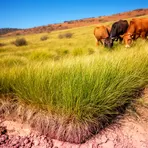
A grass that grows in warm places used to feed animals and stop soil erosion

A grass planted to feed animals and prevent soil erosion along banks

A group of grasses that grow in warm places, often called lovegrass
Surface Forms
Morphology
love + grass
The compound follows the productive noun+grass pattern so a learner who knows 'love' and 'grass' can infer it denotes a type of grass, which gives partial comprehension. However, the specific botanical sense (genera, uses) and the reason for the modifier 'love' are lexicalized and not predictable from the constituents alone, making the relation only partially transparent.
Etymology
Love grass may come from the idea that animals 'love' to eat this plant, so the word love simply shows how good grass is as food. That's why today love grass means grasses people grow to feed animals and to stop soil from washing away.

