
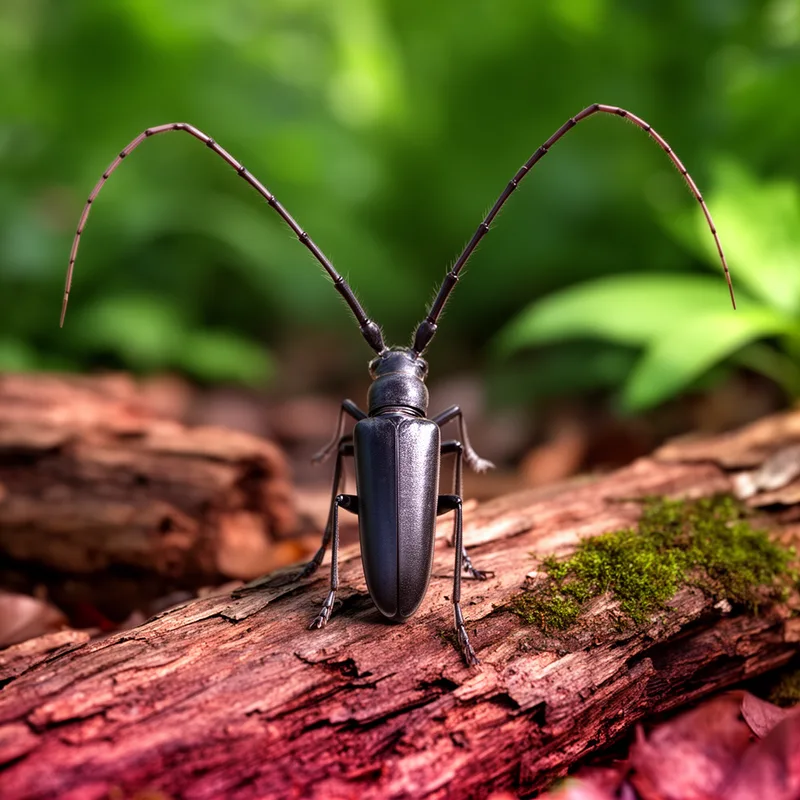
long-horned beetle
 1
7.4
1
7.4

- noun
- /lɔŋ-hɔrnd ˈbiːtəl/
- Specialized
- Newly introduced herbivores, such as the hemlock woolly adelgid and the Asian long-horned beetle, threaten the composition and integrity of much natural and managed vegetation.
- Asian long-horned beetle
Examples
-
The white circles that we see here are actual infestations of Asian long-horned beetles, which are literally eating their way through our nation's trees.
Academic text (2001) -
PHOTO (COLOR): Likewise, it is predicted that the long-horned beetle could rob the United States of its shade trees and reduce biological diversity in forests if it becomes established.
Academic text (2004) -
The Asian long-horned beetle is known for its distinctive long body and antennae.
-
Many trees are at risk due to the Asian long-horned beetle infestation spreading across urban areas.
-
Conservationists are working hard to control the population of the Asian long-horned beetle to protect local ecosystems.
Synonyms
A beetle with a long body and very long antennae that often makes holes in wood

A beetle with a long body and very long antennae often longer than its body

A group of beetles with very long antennae often longer than their bodies
Surface Forms
Morphology
long-horned + beetle
The meaning is directly compositional: 'long-horned' denotes having long horns (here referring to long antennae) and 'beetle' names the insect, so a learner who knows 'long', 'horn/ horned' and 'beetle' can infer a beetle with long horns. This adjective–noun compounding follows regular English formation and similar patterns exist cross-linguistically, making the phrase immediately understandable to a B1 learner.
Etymology
Long-horned beetle: The name long-horned beetle comes from the insect's very long antennae that look like long 'horns'. That's why horned means 'having horns' and the name helps you remember it is a beetle with long, horn-like antennae.