
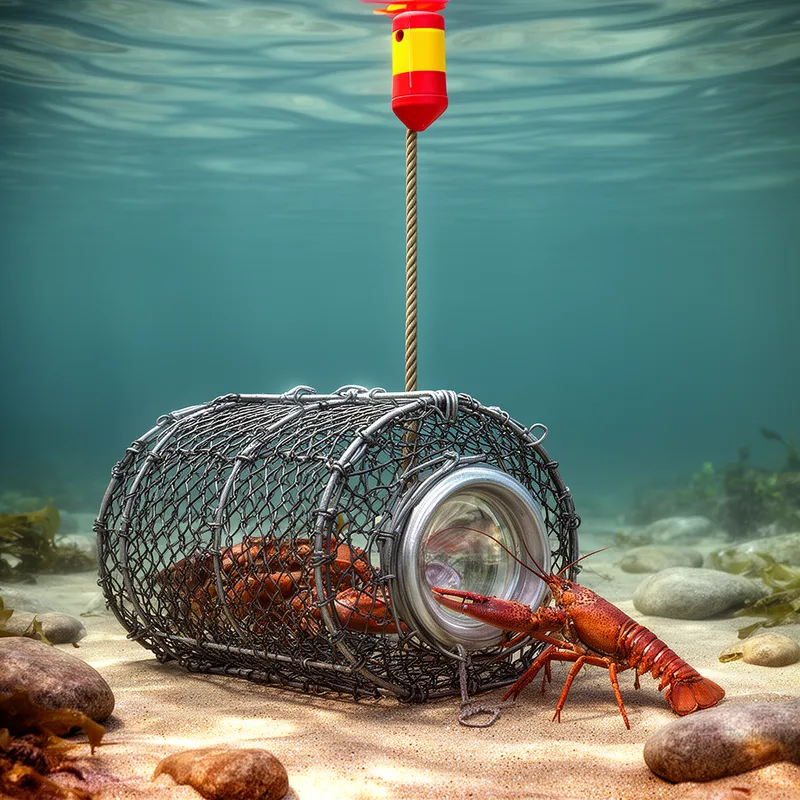
lobster pot


 1
3.5
1
3.5
- noun
- /ˈlɑːbstər pɑt/
- With his free hand, he flipped the gas jet below the slow-boiling lobster pot to high.
- haul up the lobster pot
Examples
-
His first job was to prepare the stinking bait, and when he was old enough to go out with them, it was his job to put the bait into the lobster pot.
Fiction book (2000) -
The fisherman carefully checked his lobster pot for any catch this morning.
-
Each tray is then lowered in a lobster pot, usually on a rocky bottom.
Academic text (1999) -
Hundreds of lobster pots were stacked high.
Fiction book (1999) -
But that night, before all this, Memere boiled corn in her lobster pot.
Fiction book (2001) -
A gentle breeze has started to come up from the west, ruffling an open stretch of water that lies beyond rows of inshore lobster pots.
Fiction book (2000) -
The type of lobster pot used in the bay is the same as used elsewhere in eastern North America, i.e., about 1 m long, made of tarred wooden lath; most are shaped like a half barrel, but some are square.
Academic text (1990) -
Afterwards, fishermen used winches to lift brail nets, eel and lobster pots, and crab dredges.
Academic text (1990) -
In the early morning light, the crew prepared to pull the lobster pot from the sea.
-
After a long day at sea, he was eager to see what was in his lobster pot.
Synonyms
 377
1.0
377
1.0
A round container used for cooking or holding plants
Surface Forms
Morphology
lobster + pot
The meaning 'a container or trap for lobsters' is directly and transparently derived from combining 'lobster' (the animal) with 'pot' (a vessel), and the context (‘in the water’) makes the trapping sense clear rather than a cooking pot. This compound follows a common, cross-linguistic noun + noun composition pattern, so a B1 learner who knows both constituents will reliably infer the MWE meaning.
Etymology
Lobster pot is the name for the basket-like trap fishermen use to catch lobsters. The lobster is the animal and the pot is the container; fishermen put bait inside so the lobsters go in but cannot get out, so it means 'a container or trap for catching lobsters'.