

little-leaf fig
- noun
- Australian
- Unlike the common fig, the little-leaf fig has smaller leaves and a more compact growth habit.
Examples
-
Gardeners in South Africa plant the little-leaf fig as a fast-growing source of brushwood.
-
The little-leaf fig is commonly used in landscaping for its dense foliage.
-
The little-leaf fig is a popular ornamental tree.
-
Many gardeners love the little-leaf fig for its unique appearance.
-
Gardeners in South Africa plant the little-leaf fig as a fast-growing source of brushwood.
-
The little-leaf fig is commonly used in landscaping for its dense foliage.
-
Unlike the common fig, the little-leaf fig has smaller leaves and a more compact growth habit.
Synonyms

A big Australian tree with spreading roots often planted for shade and beauty
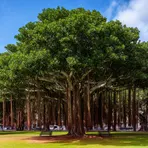
A large Australian tree with wide branches and roots that hang down, often planted for shade

An Australian fig tree that grows large and gives good shade in gardens
Surface Forms
Morphology
little-leaf + fig
The compound is compositionally built from 'little' + 'leaf' modifying 'fig', so a learner who knows 'little', 'leaf' and 'fig' can infer it denotes a fig tree with small leaves. This is a straightforward adjective-noun compounding pattern common in English (equivalent to 'small-leaved fig'), making the overall meaning transparent even if the precise botanical species is unknown.
Etymology
Little-leaf fig comes from a simple picture: people saw a fig-like tree with very small leaves and called it little-leaf and fig. That's why the name tells you it is a fig tree with small leaves, often planted for 'garden decoration' or for brushwood.

