

Ficus rubiginosa
- noun
- Specialized
- In its native Australia, the Ficus rubiginosa can grow quite large and provide excellent shade.
Examples
-
Botanists compared the Ficus rubiginosa to the closely related banyan tree.
-
The gardeners planted a Ficus rubiginosa near the entrance as a striking centerpiece.
-
The Ficus rubiginosa thrives in warm climates.
-
Have you seen a Ficus rubiginosa in bloom?
-
The gardeners planted a Ficus rubiginosa near the entrance as a striking centerpiece.
-
In its native Australia, the Ficus rubiginosa can grow quite large and provide excellent shade.
-
The Ficus rubiginosa is often cultivated for its attractive foliage and ornamental value.
Synonyms
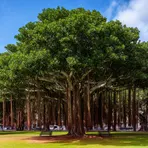
A large Australian tree with wide branches and roots that hang down, often planted for shade

An Australian tree with small leaves often grown for gardens and brushwood

A big Australian tree with spreading roots often planted for shade and beauty
Surface Forms
Morphology
Ficus + rubiginosa
The name is a Latin binomial combining Ficus (a fig genus) with the species epithet rubiginosa; if a learner knew both parts they could infer it refers to a kind of fig, likely with a rust‑colored or similar descriptive trait, but not the full sense (Australian distribution or ornamental use). Because the second element is a specialized Latin descriptor and the precise botanical/usage information is not derivable from common English vocabulary, the transparency is partial.
Etymology
Ficus rubiginosa comes from Latin: Ficus means 'fig' and rubiginosa means 'rusty'. The tree often has reddish hairs on the underside of its leaves and on young branches, so the name is like calling it a 'rusty fig' and helps you remember this fig by its colour.

