

ligamentous


 1
7.6
- adjective
- /ˌlɪɡəˈmɛntəs/
- Specialized
- This is a forward slip of one vertebra over another resulting from ligamentous laxity, degeneration, or trauma.
- ligamentous laxity
- ligamentous strain
- ligamentous injuries
Examples
-
Ligamentous tensile strength was then evaluated in vitro in a controlled fashion and found to be significantly weakened.
Academic text (2004) -
The injuries are mostly ligamentous with possible pubic rami fractures.
Academic text (2006) -
Isolated ligamentous injuries of the knee are a somewhat rare occurrence in children under the age of 14 years with open physes.
Academic text (2006) -
Part of the applied traction force is needed to overcome opposing forces, namely friction of the body on the tabletop, muscle contraction, spinal curvatures, ligamentous resistance, and friction of the machinery.
Academic text (1995) -
The vast majority of these fractures occur in the first decade of life because of the increased incidence of falls, generalized ligamentous laxity, and weakness in the bony architecture at the supracondylar area of the humerus.
Academic text (2006) -
In LC-I and AP-I pelvic fractures, the injuries are minimally displaced, and ligamentous stability of the pelvic ring still exists with partial disruption of the bony structure.
Academic text (2006) -
The doctor explained that ligamentous injuries can cause significant pain and instability in the joint.
-
Athletes are often at risk for ligamentous damage during high-impact sports like football and basketball.
-
After the accident, she underwent tests to check for any ligamentous tears in her knee.
Synonyms
 1
7.9
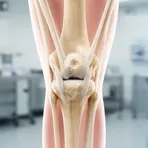
Relating to or like strong bands of tissue that connect bones
Surface Forms
Morphology
Etymology
The word ligamentous comes from ligament, which comes from the old Latin ligare, meaning 'to bind'. A ligament is a strong band that binds bones together, so ligamentous means 'relating to' or 'like a ligament' in the body.