
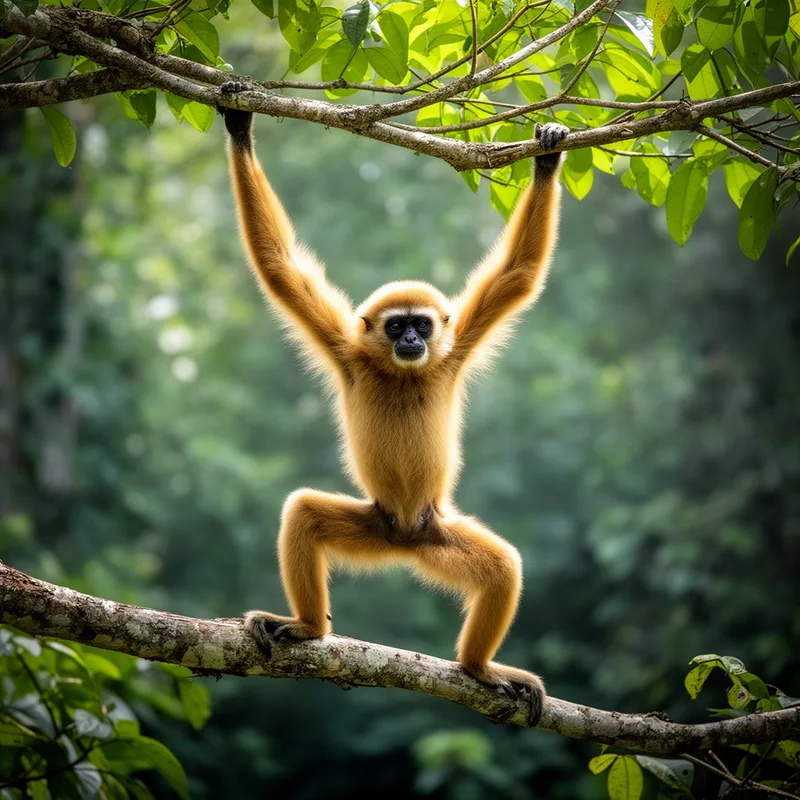
lesser ape
- noun
- /ˈlɛsər eɪp/
- The siamang, a type of lesser ape, has a distinctive throat pouch used to amplify its calls.
Examples
-
Unlike great apes, the lesser ape family is known for their remarkable agility in the treetops.
-
The lesser ape is known for its agility.
-
Gibbons are the most well-known species of lesser ape found in Southeast Asia.
-
Many lesser apes are found in the forests of Southeast Asia.
-
The lesser ape, known for its long arms, swings gracefully from branch to branch.
-
Unlike great apes, lesser apes are agile and move quickly through the trees.
-
Researchers studied the behavior of lesser apes to understand their social structures.
Synonyms

A group of small apes that live in trees like gibbons and siamangs
Surface Forms
Morphology
The meaning is directly compositional: 'lesser' (smaller/lesser in significance) modifies 'ape', yielding the straightforward sense of smaller or less large apes (e.g., gibbons and siamangs). This follows a common adjective + noun pattern found across languages, so a B1 learner who knows both words can infer the intended biological contrast with 'great apes'.
Etymology
Lesser ape comes from joining lesser and ape to show these are 'smaller' apes, not the big 'great apes'. Because they are small, long-armed, tree living gibbons and siamangs that swing through branches, the name now means a group of small, agile apes.

