
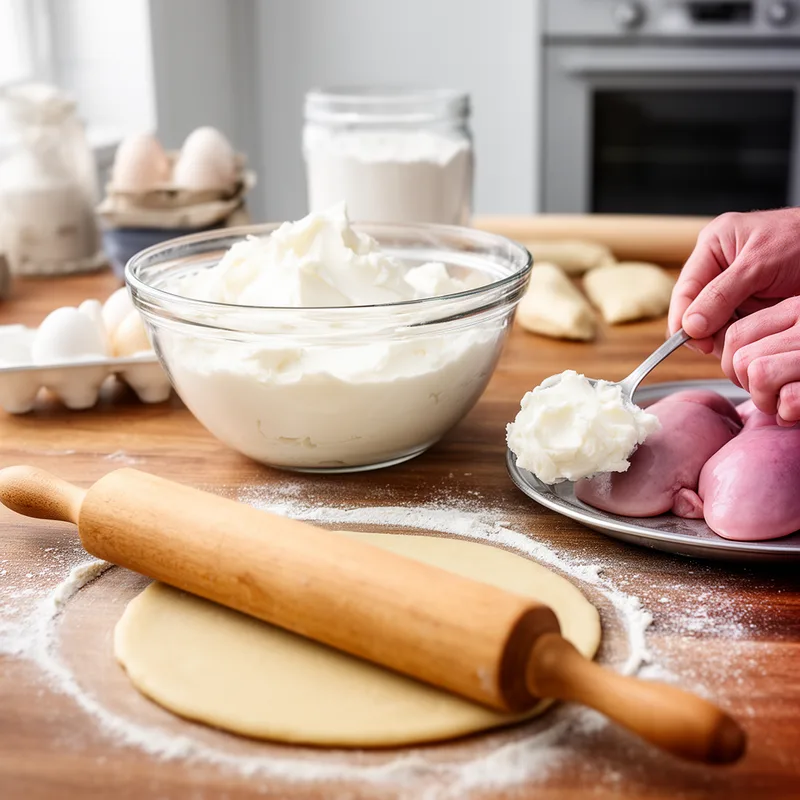
leaf lard
 1
8.7
1
8.7

- noun
- /liːf lɑrd/
- Specialized
- When you render fat from leaf lard, you get a beautiful white, subtle-tasting fat that's perfect for baking or frying.
- leaf lard and butter crust
Examples
-
The butcher separated the leaf lard from the fatback, and following your directions, I am going to render the lard today.
Blog text (17) -
Your post was timely as my husband's office is holding a pie contest, and I now have a new goal for learning how to render leaf lard.
Blog text (17) -
Cut your leaf lard or back fat into small pieces.
Blog text (17) -
Finding the leaf lard is the hardest part of the process.
Blog text (17) -
Thanks to my butcher who sent me 5 lbs of leaf lard from his organic pig farm.
Blog text (17) -
I'm about to render my first batch of leaf lard, and I'm aiming for the "snow white" look.
Blog text (17) -
Leaf lard is used to make perfectly flaky pie crusts and traditional Spanish polvorones.
Blog text (17) -
Many chefs prefer using leaf lard when baking because it produces a flakier crust.
-
When you render fat from leaf lard, you get a beautiful white, subtle-tasting fat that's perfect for baking or frying.
-
You can enhance your cooking by using leaf lard as a substitute for butter or oil.
Synonyms


Surface Forms
Morphology
leaf + lard
While a learner who knows 'leaf' and 'lard' can infer that this is a particular kind or part of lard (so the compound signals a subtype), the specific sense — fat from around the kidneys and abdomen used in baking — is specialized and not derivable from the literal meanings. 'Leaf' here is a technical label rather than the common plant sense, so partial inference is possible but the exact culinary/anatomical meaning requires prior exposure.
Etymology
Leaf lard gets its name from the thin leaf of fat that lies around a pig's kidneys; this soft lard looks like a small leaf and has a mild taste. That's why leaf lard today means the high-quality pork fat bakers use to make flaky, light baked goods.